 Book a tour
Brú na Bóinne National Park
Brú na Bóinne National Park sits in the Boyne Valley, about an hour from Dublin. The land is low and fertile. In addition, cairns, castles and older earthworks still mark a bend of the River Boyne. So this is one of the richest prehistoric landscapes in Ireland.
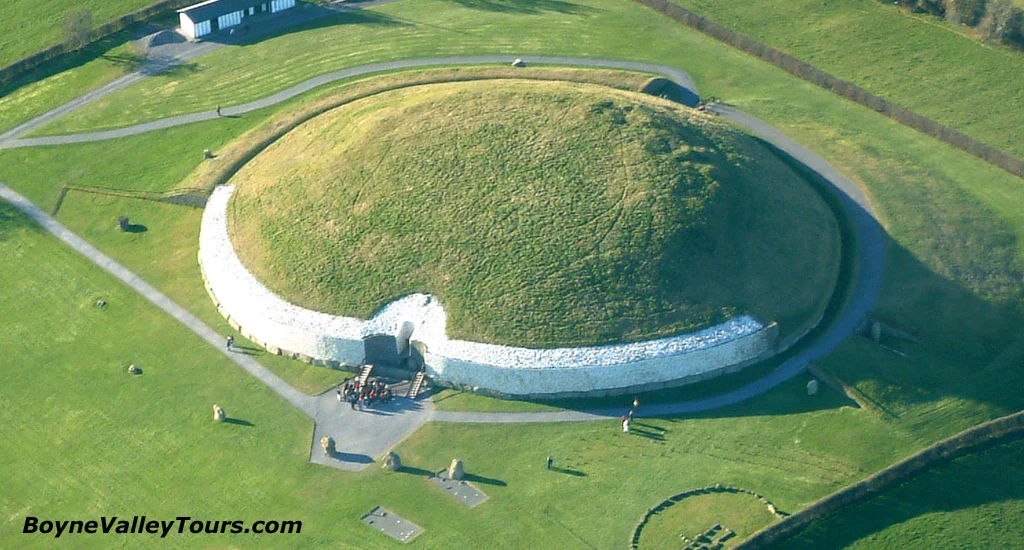
Newgrange Passage Tomb in Brú na Bóinne National Park.
This is Ireland’s seventh national park, and the smallest. It follows the purchase of the Dowth Hall estate, a historic tract bounded by about two miles of the River Boyne. The park also takes in the existing state-owned land at Newgrange and Knowth. Together they form a large ancient cemetery. There are dozens of satellite tombs. Then there is Europe’s richest concentration of megalithic art. Dowth also adds later houses close to the prehistoric sites.
Sites within Brú na Bóinne National Park
Brú na Bóinne National Park has more to see than one short stop. A full day helps. If time is tight, start with the 43 hectare (106 acre) area that holds Newgrange and Knowth.
Newgrange
For many visitors, Newgrange is the first stop in Brú na Bóinne National Park. It stands on the original state-owned plot. People have come here for centuries. For example, Victorian tourists even scratched names on the stones. The white quartz wall and mound sat buried under clay for a long time. Builders raised it more than 5,000 years ago. That therefore makes it older than the pyramids at Giza and older than Stonehenge.
The mound rises about 13 meters (43 feet). It is about 85 meters (279 feet) across. 97 kerbstones ring it, many of them carved. Stone came from as far as Wicklow. Inside, a passage of about 19 meters (62 feet) leads to the chamber under a corbelled roof. On a standard OPW tour, visitors do enter that passage and chamber. Around the winter solstice, sunrise can also light the chamber through the roof-box.

Newgrange megalithic passage tomb in the Brú na Bóinne World Heritage Site.
Knowth
Knowth sits close to Newgrange. It is of similar date. The main mound has two long passages and a ring of smaller satellite tombs. Carved slabs stand around the kerb. In many ways, the art is what sets Knowth apart. Digs since 1962 have shown more decorated stone here than at any other Neolithic site of this kind in western Europe. Life continued on the mound through later ages. Because of that, the long sequence is part of the draw. Archaeological work is still going on.
Visitors see the mound, the kerbstones and the setting. However, they do not enter either passage.
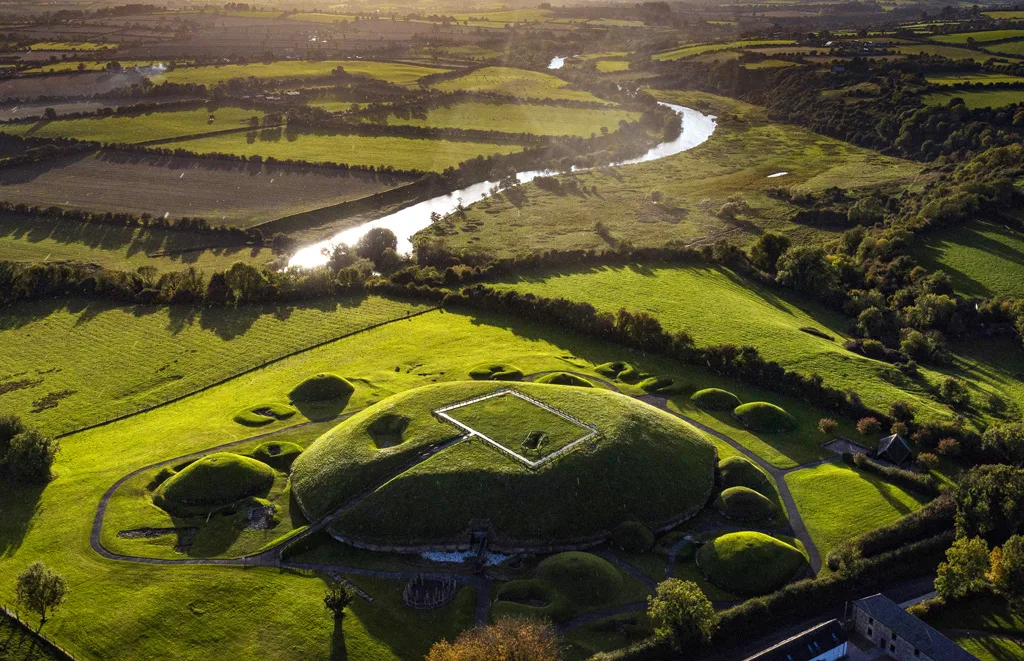
Knowth megalithic passage tomb and the River Boyne in the Brú na Bóinne World Heritage Site.
A bus from the Brú na Bóinne Visitor Center at Donore takes you to both Knowth and Newgrange. Time at the center helps. It gives the backstory before you reach the mounds.

Brú na Bóinne Visitor Center.
Dowth Demesne
The Dowth demesne adds about 223 hectares (551 acres). With Newgrange and Knowth, it brings more ruins into the park. These include the late Neolithic Dowth henge, the Dowth passage tomb and other tombs. You will also find a Norman castle, ring forts, a Bronze Age field system, Georgian Dowth Hall and Victorian Netterville Manor.
Dowth Hall
For a long time, the Netterville family controlled this north-east corner of Brú na Bóinne. They held the Dowth estate for about six centuries. First they lived in a stone tower house. Family stories include shifting local alliances and a murder trial. The butler was the victim. Then the fifth viscount was the alleged killer.
John, the sixth and last viscount of that direct line, built Dowth Hall in 1745. It stands on the southern bank of the Boyne, over a Neolithic passage tomb. The house covers about 970 square meters (10,400 square feet). It needs careful repair by the National Parks and Wildlife Service. Still, it has a grand hall, a cantilevered staircase, a fine cast-iron stove, and detailed rococo plaster and marble.

Dowth Hall in Brú na Bóinne National Park.
Dowth passage tomb
Dowth is the third great passage tomb in Brú na Bóinne. It is about 15 meters (49 feet) high. The new national park now links it with Newgrange and Knowth. The mound survived rough treatment in the Netterville years. For example, dynamite used in a crude dig left a crater. There was also a tea house on the summit. The tomb is about 5,000 years old. The south passage faces the setting sun at the winter solstice.

Dowth megalithic passage tomb in the Brú na Bóinne World Heritage Site.
Netterville Manor
This red-brick Victorian Gothic house was built as an almshouse for widows and orphans in 1877. Owners refurbished it in recent years. It sits in the same complex as the castellated medieval tower house. That was the old Netterville home. It was also the birthplace of writer, poet and activist John Boyle O’Reilly. He left a mark in Australia and America. President John F. Kennedy sometimes quoted him. Finally, his statue stands by a mossy church to the rear, close to a rare sheela-na-gig.
Dowth Henge
This large, egg-shaped enclosure lies about 1 kilometer (0.6 miles) south-west of the Dowth passage tomb. It is therefore the largest of four henges in Brú na Bóinne.

Dowth Henge in Brú na Bóinne National Park.
Sites beyond Brú na Bóinne National Park
Little remains of the great palaces of the high kings on the Hill of Tara. You can still see traces of that role, such as Lia Fáil, the coronation stone. The views across the countryside are wide too. A short drive north from the Brú na Bóinne Visitor Center, the Battle of the Boyne visitor center covers a turning point in Irish history. A boat trip on the river then gives another view of that landscape. Meanwhile, Trim Castle, used in the film Braveheart, is about 20 minutes south-west of Tara.

Mound of the Hostages on the Hill of Tara.
Text credit: The Guardian
Visit Brú na Bóinne National Park with Boyne Valley Tours
Enjoy a private day tour from Dublin to the Boyne Valley. We tailor the itinerary to your interests and handle the driving and logistics. The OPW-guided visit from the Brú na Bóinne Visitor Center includes Newgrange and Knowth. Afterwards, continue to the Hill of Slane and the Hill of Tara. Because this is a private tour, you can choose other sites instead.

Newgrange & Boyne Valley

8hrs | €700 + Booking Fees


Boyne Valley Castles & Abbeys
8hrs | €700 + Booking Fees

Meath Megalithic Sites
8hrs | €700 + Booking Fees

Glendalough & Scenic Wicklow
8hrs | €700 + Booking Fees

Wicklow Gardens & Scenery
8hrs | €700 + Booking Fees

Cruise Excursions
8hrs | €700 + Booking Fees
