Book a tour
Newgrange light and myth
This look at Newgrange light and myth begins in the Boyne Valley of County Meath, home to one of Europe’s most extraordinary prehistoric monuments. Built around 3200 BC, it is older than Stonehenge and the great pyramids of Egypt. More than a burial monument, Newgrange stands as a powerful expression of Neolithic skill, belief, and social organization.
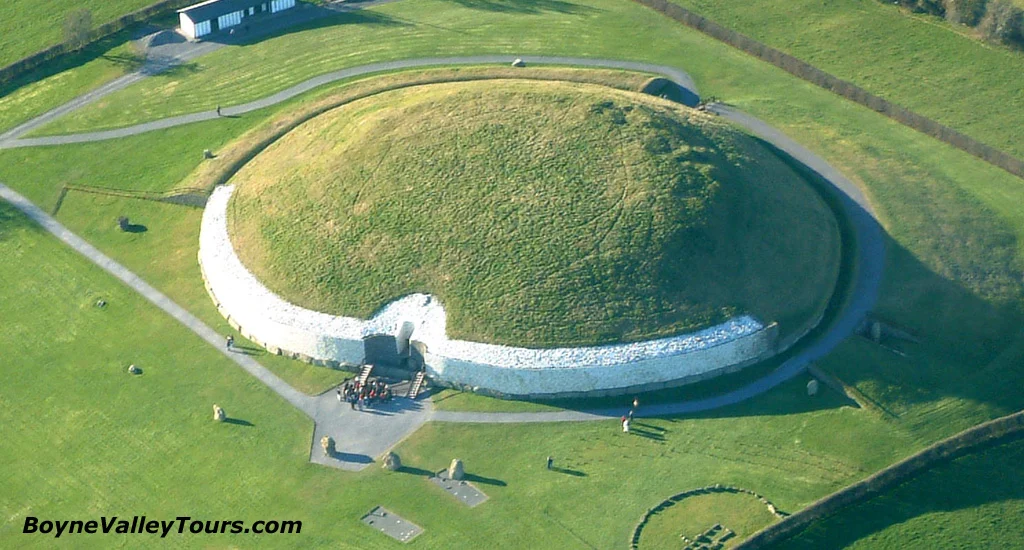
Newgrange stands as a powerful expression of Neolithic skill and social organization
Its immense scale still impresses today. Huge stones were quarried, transported, and carefully placed long before the use of metal tools, wheeled vehicles, or modern machinery. The very existence of Newgrange shows that the farming communities of Neolithic Ireland were capable of remarkable planning, cooperation, and engineering.
An Astonishing Feat of Construction
Newgrange was not built by a small isolated group. The monument required a major communal effort, involving the movement of large stones and the gathering of materials from considerable distances. White quartz was brought from the Wicklow Mountains, while darker rounded stones came from the north. This selection of materials reflects not only technical ability but also a deliberate visual design.

Entrance to the Newgrange passage tomb, where visitors enter the passage leading to a 5,000 year old chamber.
The cairn itself contains a vast mass of stone and earth, and its carefully engineered interior has remained dry for millennia. Excavations led by archaeologist Michael J. O’Kelly demonstrated the precision of its construction, including a corbelled roof that still keeps the chamber largely waterproof. This durability points to a monument designed with long-term purpose and permanence in mind.
Newgrange light and the winter solstice
Newgrange is world famous for its winter solstice alignment. At sunrise on mornings around the shortest day of the year, a narrow opening above the entrance allows sunlight to enter the passage. The beam moves slowly inward until it reaches the inner chamber, briefly illuminating the space.
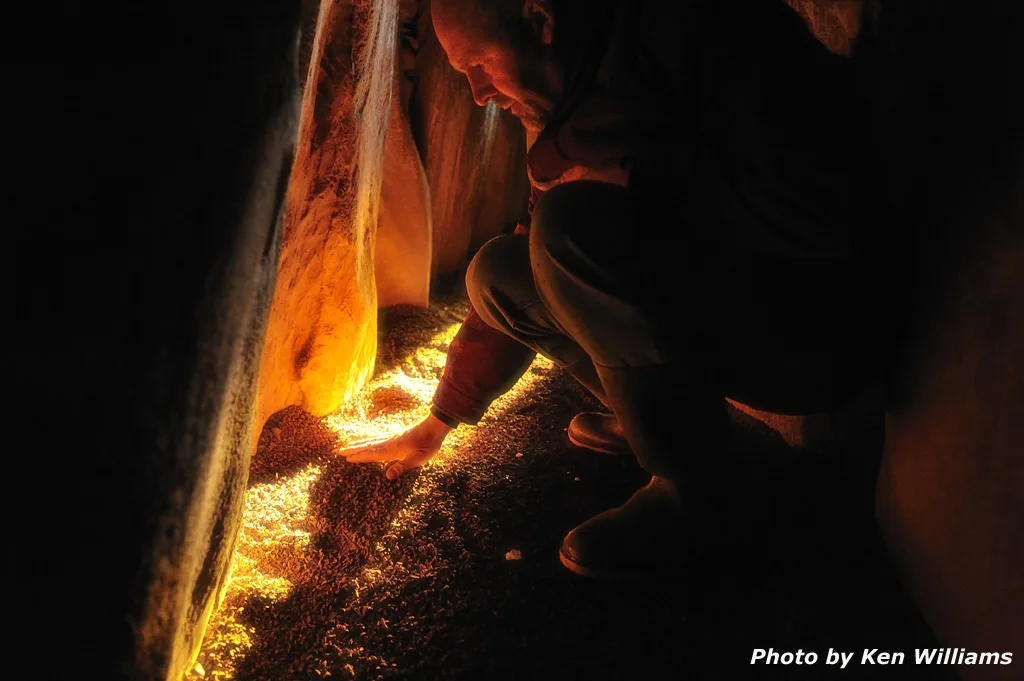
Winter Solstice Sunrise in the Newgrange chamber
This alignment reflects a precise understanding of the solar year. For early farming communities, the winter solstice marked a critical seasonal turning point. At Newgrange, this moment may have been transformed into a powerful ritual event symbolizing renewal, continuity, and the return of light.
Myth and memory at Newgrange
Long after its construction, Newgrange entered Irish tradition as Brú na Bóinne, the great dwelling of the Boyne. In medieval literature and folklore, it became associated with figures such as Boann, the Dagda, and Aengus Óg. These stories present the mound as a place of supernatural significance, linked to the Otherworld and divine beings.

Known in Irish tradition as Brú na Bóinne, the great mound later called Newgrange became associated with Boann, the Dagda and Aengus Óg as a supernatural dwelling of the Otherworld.
Although written thousands of years after the monument was built, these traditions show how strongly Newgrange continued to shape cultural memory, long after its original purpose had faded.
A Ceremonial Place of the Dead
Archaeological evidence confirms that Newgrange played a role in funerary practice, where both cremated and unburnt human remains were placed within the chamber together with objects such as beads, bone pins, pendants, and flint tools. These finds reflect controlled and symbolic deposition rather than ordinary burial.

Newgrange, a 5,000 year old passage tomb, stands as Ireland’s most iconic prehistoric monument
Ancient DNA analysis has provided further insight into the individuals buried within the monument. One individual was identified as the child of a very close familial union, most likely between first-degree relatives. This rare pattern has been interpreted by researchers as evidence for a socially elevated lineage, suggesting that burial within Newgrange was restricted to a select group rather than the wider community.
Combined with the relatively small number of interments and the carefully protected interior of the chamber, this evidence supports the interpretation of Newgrange as a highly controlled ceremonial space, possibly reserved for individuals of particular status or ritual importance.
Authority and Social Status in Neolithic Ireland
The emerging scientific evidence points toward a society capable of organizing large-scale construction while also maintaining clear social distinctions. Passage tombs such as Newgrange may have served as focal points for authority, where power, ancestry, and ritual were closely connected.

Kerbstone K1 at Newgrange is the richly carved entrance stone, famed for its iconic triple spiral design.
These monuments were not isolated structures but part of a broader network of major ceremonial sites across Ireland. Comparable complexes at Carrowmore and Carrowkeel in County Sligo suggest shared traditions, long-distance connections, and a landscape shaped by ritual and social hierarchy.
Part of a Wider Sacred Landscape
Newgrange did not stand alone. It forms part of the wider Brú na Bóinne complex, alongside Knowth and Dowth, together creating one of the most significant prehistoric ceremonial landscapes in Europe. The importance of this area continued long after the main monuments were built, with successive generations returning to the landscape for ritual, gathering, and remembrance.

The back of the Newgrange mound, directly opposite the chamber entrance
Evidence for gathering, ritual activity, and feasting in the surrounding landscape suggests that Newgrange functioned as more than a burial monument. It likely served as a central place for seasonal ceremonies and communal gatherings, reinforcing shared identity among early farming communities.
A Monument That Still Speaks Across Millennia
Newgrange continues to fascinate because it brings together engineering, astronomy, ritual, and mythology in a single structure. It shows what Neolithic communities could build. It also shows a lasting wish to link the living, the dead and the sky.

Northern Lights (Aurora Borealis) at Newgrange
More than 5,000 years after it was built, Newgrange still captures the imagination. It remains one of Ireland’s greatest prehistoric achievements, not only because of its age, but because of the sophistication, symbolism, and mystery built into its stones.
Newgrange Winter Solstice Archive

- 21st December 2025 Winter Solstice
- 19th December 2024 Winter Solstice
- 19th December 2023 Winter Solstice
- 20th December 2022 Winter Solstice
- 20th December 2020 Winter Solstice
- 18th December 2016 Winter Solstice
- 20th December 2015 Winter Solstice
- 19th December 2014 Winter Solstice
- 21st December 2013 Winter Solstice
- 18th December 2011 Winter Solstice
- 22nd December 2010 Winter Solstice
- 19th December 2010 Winter Solstice
- 18th December 2010 Winter Solstice
- 22nd December 2009 Winter Solstice
- 21st December 2009 Winter Solstice
- 21st December 2008 Winter Solstice
- 21st December 2007 Winter Solstice
- 22nd December 2006 Winter Solstice
- 21st December 2006 Winter Solstice
- 21st December 2005 Winter Solstice
- 20th December 2005 Winter Solstice
- 21st December 2004 Winter Solstice
- 19th December 2004 Winter Solstice
- 21st December 2003 Winter Solstice
- 22nd December 2002 Winter Solstice
- 21st December 2001 Winter Solstice
Visit Newgrange with Boyne Valley Tours
Enjoy a private day tour from Dublin to the Boyne Valley. We tailor the itinerary to your interests and handle the driving and logistics. The OPW-guided visit from the Brú na Bóinne Visitor Center includes Newgrange and Knowth. Afterwards, continue to the Hill of Slane and the Hill of Tara. Because this is a private tour, you can choose other sites instead.

Newgrange & Boyne Valley

8hrs | €700 + Booking Fees


Boyne Valley Castles & Abbeys
8hrs | €700 + Booking Fees

Meath Megalithic Sites
8hrs | €700 + Booking Fees

Glendalough & Scenic Wicklow
8hrs | €700 + Booking Fees

Wicklow Gardens & Scenery
8hrs | €700 + Booking Fees

Cruise Excursions
8hrs | €700 + Booking Fees