Book a tour
A private Boyne Valley tour can include a visit to the intimate passage tomb at Fourknocks. The mound sits on a ridge near Ardcath and the Naul, about 16 kilometres (10 miles) southeast of Newgrange and about an hour north of Dublin. We collect you from your hotel in the morning and return you that evening, arranging access so you can explore the chamber at your own pace.

Sheep grazing on the approach to Fourknocks mound
Fourknocks has no visitor center or admission ticket, but its chamber is locked and access requires a locally held key. We arrange this for you. When Newgrange and Knowth are included in your itinerary, we also purchase the required Brú na Bóinne tickets on your behalf, subject to availability.
Access to Fourknocks involves crossing a stone stile, so the chamber visit is not wheelchair accessible. Wear comfortable shoes and bring an extra layer for exposed sites. We can customize the other stops to suit your interests and preferred level of walking.
What you will see at Fourknocks
A typical visit includes the outdoor mound, the ridge views, and time inside the chamber. Unlike Knowth, visitors do enter the passage and chamber when the key is available. The Irish name is usually given as Na Fuarchnoic, the Cold Hills. Many visitors underrate Fourknocks until they step inside. The pear-shaped chamber is unexpectedly spacious, the carvings are close enough to study without a rope barrier, and there is no visitor center crowd.
The mound and ridge setting
From the field, Fourknocks reads as a neat grass mound behind a protective fence. The ridge position above the Delvin Valley is part of the point. On a clear day the wider countryside opens out, and the site feels chosen for outlook as well as burial. Nearby mounds show that Fourknocks was part of a small local complex, not a lonely one-off hill.

Fourknocks Passage Tomb
The entrance and short passage
The entrance faces roughly northeast. You approach on a short gravel path to a stone doorway set into the mound. Once unlocked, the passage is brief compared with Newgrange’s 19-meter (62-foot) corridor. That short approach is part of the intimacy: within a few steps you are in the main chamber.

The entrance into the Fourknocks passage tomb
Chamber, recesses and megalithic art
Inside, the pear-shaped chamber and three recesses give you room to stand and look. The art is angular and confident: zigzags, chevrons, lozenges and diamond-shaped motifs pecked into sandstone. Some lintel carvings are still remarkably sharp. Decorated lintels and uprights sit close to eye level, so the designs are easier to read here than on many outdoor kerbstones elsewhere in the Boyne Valley. As with other Boyne Valley art, the original meaning is uncertain. Visitors and researchers variously read the motifs as celestial, spiritual or simply decorative.
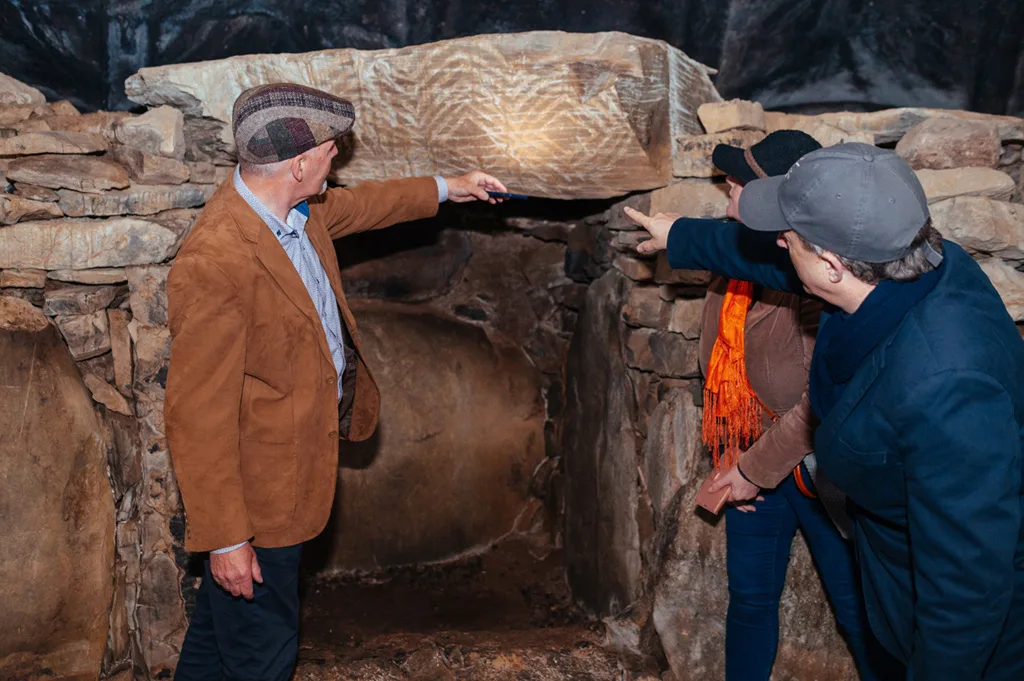
Megalithic Art inside Fourknocks Megalithic Passage Tomb
The Face Stone
Just inside the chamber, to the left as you enter, stands the Face Stone, about 1 meter (3 feet) high. Many visitors read the concentric circles and zigzags as a stylized human face and torso. Whether the makers intended a face is still debated, but it is among the most talked-about carvings in Irish passage tomb art, and it gives Fourknocks a presence you do not forget.

The Face Stone inside the Fourknocks chamber
How a private day usually runs
A full private day from Dublin usually starts with Brú na Bóinne. That block often takes about three hours, including the exhibition. Newgrange is the main OPW-guided visit. Knowth is included when it is open.
Fourknocks can follow as the contrast stop: a local-scale tomb where you can stand inside among the art without the visitor center shuttle. You can also pair it with Tara, Slane or other Meath megalithic sites. This is a private tour, so you can choose other Boyne Valley sites instead. Two extra stops after Brú na Bóinne are realistic.
Wear shoes for grass and a stile. Bring a layer, and a small torch if you want extra light on the carvings. Shelter at the monument is limited.
What Fourknocks is
Fourknocks is a cruciform passage tomb under a round mound that originally measured about 30 meters (98 feet) across. Built around 3000 BC, it belongs to the same broad world as Brú na Bóinne, but it feels different on the ground: smaller, quieter, and open to the chamber when you have the key. A short stone-lined passage, about 5 meters (16 feet) long, leads into a wide pear-shaped chamber with three side recesses.
Unlike Newgrange, Fourknocks does not preserve a corbelled stone roof. Excavation found a central posthole in the chamber floor, which points to an original timber support and a lighter roof of wood and turf. Today a modern concrete dome protects the interior while still letting you enter and see the carved stones.
P. J. Hartnett excavated Fourknocks I in 1950 for the National Museum, with further work on nearby mounds in 1951 and 1952. The dig recovered the remains of more than 65 people, adults and children, both cremated and unburnt, along with decorated pottery, beads, pendants, bone pins and an antler pin. Those finds are now in the National Museum collections. The chamber you visit is the place they came from.

The entrance to the 5,000-year-old passage tomb at Fourknocks
Fourknocks FAQ
Planning the visit
How does Fourknocks fit a private day from Dublin?
The Boyne Valley is about one hour north of Dublin. Your private tour includes hotel pickup and return that evening. Fourknocks is a separate roadside stop, not part of the visitor-center shuttle. It often sits after Newgrange and Knowth, or with other Meath megalithic sites.
How long should we allow at Fourknocks?
Plan about 45 minutes to an hour, or longer if you want extra time with the carvings.
Who guides us at Fourknocks?
Your private guide frames the site and handles the key arrangement. There is no OPW shuttle tour here.
Can we go inside Fourknocks?
Yes. With the key, visitors enter the passage and chamber. On a Boyne Valley Tours private day, the key arrangement is handled for you.
Tickets
Do we need tickets for Fourknocks?
No. There is no visitor-center ticket. The exterior mound can be viewed freely. Interior access needs the local key. On a private tour we coordinate that as part of the day. Independent visitors contact the White family before 6 pm, leave a refundable cash deposit, and return the key the same day. Newgrange and Knowth still need Brú na Bóinne tickets when those sites are on your day. Many outdoor Boyne Valley monuments do not need an entry ticket.
Is Fourknocks on the Brú na Bóinne Visitor Center tour?
No. Newgrange and Knowth use the visitor center shuttle. Fourknocks is a separate roadside stop.
Walking
How much walking is involved?
Expect grass, a short gravel path and a stone stile. The chamber visit is not wheelchair accessible. Shelter at the monument is limited, so bring a waterproof jacket and an extra layer.
Can the day be adjusted for mobility or personal interests?
Yes. This is a private tour, so we can customize later stops. Tell us if you prefer less walking, more time at one site, or a different mix of tombs, abbeys or later history.
Lunch and other practical questions
Is there time for lunch?
Yes. We stop for lunch during the day. The tour price does not include meals.
Are tolls, fuel and parking included?
Yes. All car expenses are covered by the tour price, including tolls, fuel and parking.
What is the Face Stone?
It is a carved upright just inside the chamber that many people read as a stylized human face. It is one of the best-known motifs at any Irish passage tomb.
Is it aligned like Newgrange at the solstice?
Fourknocks does not have a Newgrange-style roof-box solstice beam. Its value is the chamber, the art and the quiet ridge setting.
Visit Fourknocks with Boyne Valley Tours
Enjoy a private day from Dublin. We handle the driving, the timing and the Fourknocks key. Fourknocks itself does not need a visitor-center ticket. If the day also includes Newgrange or Knowth, we purchase those Brú na Bóinne tickets on your behalf, subject to availability. Tell us if you want less walking, more abbeys or a quieter tomb instead. You can see the wider choice of Boyne Valley sites on the companion page.

Newgrange & Boyne Valley

8hrs | €700 + Booking Fees


Boyne Valley Castles & Abbeys
8hrs | €700 + Booking Fees

Meath Megalithic Sites
8hrs | €700 + Booking Fees

Glendalough & Scenic Wicklow
8hrs | €700 + Booking Fees

Wicklow Gardens & Scenery
8hrs | €700 + Booking Fees

Cruise Excursions
8hrs | €700 + Booking Fees