Book a tour
A private Boyne Valley tour offers a relaxed day exploring Ireland’s ancient past without rushing from one monument to the next. The valley is about an hour north of Dublin, with morning pickup from your hotel and return that evening.
Most first-time visitors spend about three hours at Brú na Bóinne, leaving time for two additional stops. A popular itinerary combines Newgrange with the Hill of Tara and the Hill of Slane. When open, Knowth is included as part of the Brú na Bóinne visit.
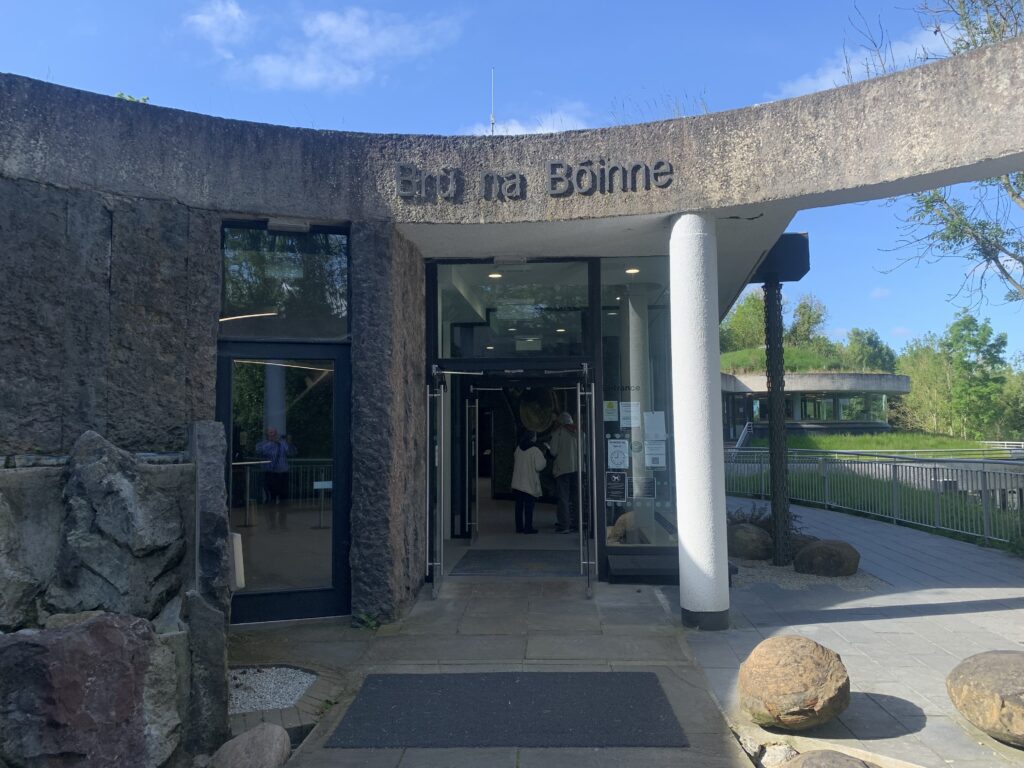
The Brú na Bóinne Visitor Center near Donore
We purchase the required tickets on your behalf, subject to availability. If Newgrange is sold out, we will adjust the itinerary to include other rewarding sites, such as Fourknocks, Tara, Trim Castle or one of the valley’s historic abbeys. Time is allowed for lunch, although meals are not included in the tour price.
The tour involves walking on gravel paths, grass and uneven ground, and some monuments have steps. The passage at Newgrange is narrow, while Loughcrew requires a steeper climb and its chamber is currently closed. As archaeological sites offer little shelter, bring sturdy shoes and an extra layer. We can customize the route if you prefer less walking or a different combination of sites.
Places You Can Include
Brú na Bóinne is the Boyne Valley’s best-known archaeological landscape. Newgrange, Knowth and Dowth form a UNESCO World Heritage Site. The OPW Brú na Bóinne Visitor Center is the starting point for guided visits. An OPW guide leads your tour of Newgrange, with Knowth included when it is open during the main season.
Other popular sites include the Hill of Tara, Hill of Slane, Trim Castle, Monasterboice, Mellifont Abbey and Bective Abbey. You might also consider Loughcrew, Kells or the Battle of the Boyne.
There is too much to see in a single day. After visiting Brú na Bóinne, two additional stops usually make for a comfortable and enjoyable itinerary.
Stone Age sites
Neolithic farmers built the great passage tombs about 5,000 years ago. They predate the pyramids of Giza and the main stone circle at Stonehenge. Today they are the reason many people come to County Meath. A private day almost always starts with at least one of these mounds.
Newgrange
Newgrange is the best-known monument in Brú na Bóinne. Builders raised the mound around 3200 BC. A long, narrow passage leads to a stone chamber. On mornings around the winter solstice, sunlight reaches that chamber through the roof-box.
You start at the visitor center near Donore. A shuttle takes you to the mound. An OPW guide leads the visit. Guests do enter the passage and chamber on the standard tour. The passage is low and narrow in places and may not suit guests with claustrophobia or limited mobility.
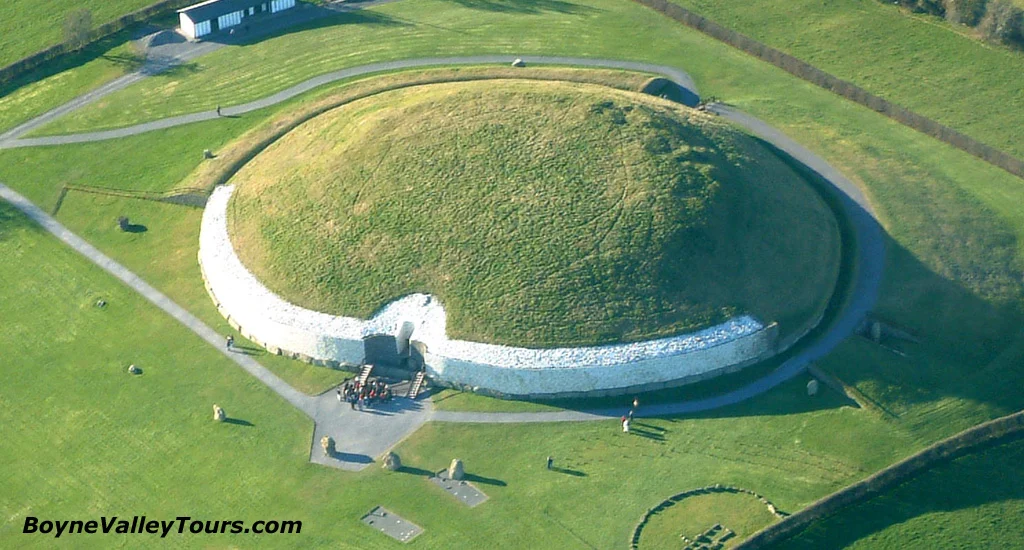
The Newgrange passage tomb in the Boyne Valley
Knowth
Knowth stands west of Newgrange on the same World Heritage landscape. The great mound has two passages set back to back. Eighteen smaller tombs sit around it. Knowth also holds the largest collection of megalithic art in Western Europe.
Guests do not enter either passage. You walk the mound with an OPW guide and see the carved kerbstones at close range. Knowth tours usually run in the main season. When Knowth is open, the OPW-guided visit from the visitor center includes it with Newgrange. When it is closed, the Brú na Bóinne stop is Newgrange.

The Great Mound and satellite tombs at Knowth
Dowth
Dowth completes the three great Brú na Bóinne mounds. It is a quieter stop after the visitor-center visit. You look across the same bend of the Boyne. Unlike Newgrange, this mound was never given a restored quartz wall. Tradition also links Dowth with sunset around the winter solstice. There is no public chamber tour here.

The mound at Dowth in morning light
Loughcrew Cairns
The Loughcrew Cairns rise above the countryside near Oldcastle. This hilltop passage tomb complex offers a quieter and more rugged contrast to Brú na Bóinne. Cairn T, the principal monument on Carnbane East, is known for its Stone Age art and its alignment with the rising sun around the spring and autumn equinoxes.
The interior of Cairn T is currently closed for conservation, so visitors explore the surrounding landscape and view the monuments from outside. Climbing on the cairn is not permitted. The walk is much steeper than the paths at Brú na Bóinne, and sturdy shoes are recommended. From the summit, there are extensive views across County Meath.
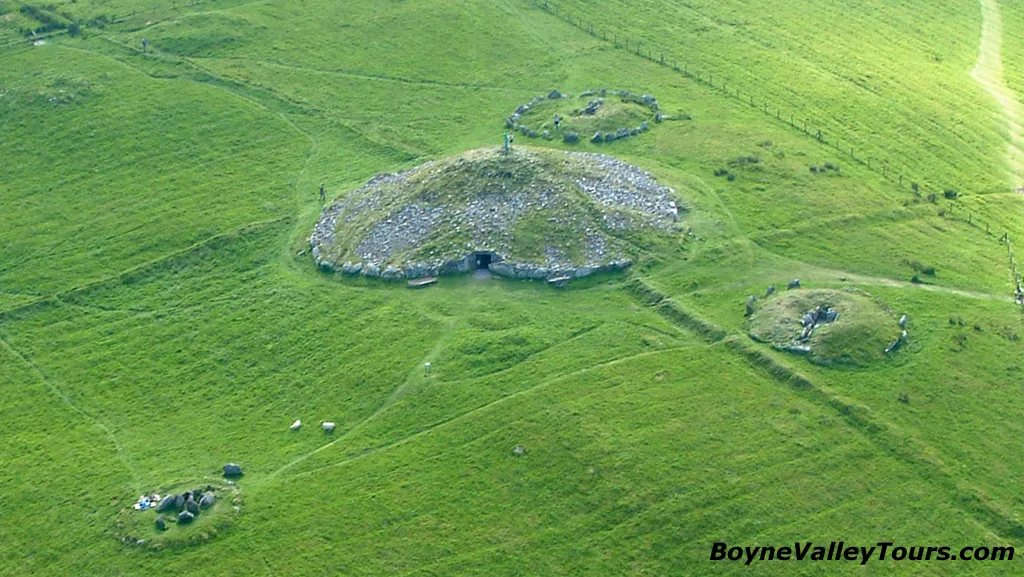
Loughcrew cairns on Carnbane East
Fourknocks
Fourknocks is a smaller passage tomb southeast of Newgrange and one of the Boyne Valley’s quieter prehistoric sites. Its spacious chamber contains several surviving examples of megalithic art.
When time and access allow, Fourknocks offers a more personal encounter with a passage tomb after the main Brú na Bóinne visit. For more prehistoric sites, explore our guide to Meath’s megalithic attractions.

The passage tomb at Fourknocks
Royal hills
Later centuries turned some heights into royal and ritual places. Two hills appear on almost every first-time itinerary. Guests often remember the views and the stories told on those summits.
Hill of Tara
The Hill of Tara is an ancient ceremonial landscape associated with the High Kings of Ireland and a highlight for many first-time visitors. Its oldest monument, the Stone Age passage tomb known as the Mound of the Hostages, predates the hill’s later earthworks.
During your guided visit, you walk among the grass-covered banks and ringforts while your guide explains Tara’s archaeology, history and legends. The visit also offers sweeping views across the surrounding countryside. Allow about one hour to explore the principal monuments.

The Hill of Tara in County Meath
Hill of Slane
The Hill of Slane rises about 158 meters (518 feet) above the countryside. Tradition says Saint Patrick lit his Paschal fire here in the fifth century, in sight of Tara. Ruins of a later Franciscan church and college still stand on the summit.
The Hill of Slane fits easily into a Boyne Valley tour after Brú na Bóinne because the drive is short. The hill offers extensive views across the surrounding countryside. Nearby Slane Castle is a separate, ticketed estate visit when it is open.
Abbeys and early Christian sites
After the Stone Age tombs, the next great layer is early Christianity. Round towers, high crosses and Cistercian abbeys mark that change.
Monasterboice
Monasterboice is one of Ireland’s finest early Christian sites. Saint Buite founded the community. The round tower and the carved high crosses are the main draw. Muiredach’s Cross stands about 5.5 meters (18 feet) high and shows detailed biblical scenes.
The round tower is closed to climb. Your Boyne Valley Tours guide interprets the carved high crosses and the monastic site, including the biblical scenes on Muiredach’s Cross.

Muiredach’s Cross at Monasterboice
Kells
Kells is a monastic town linked with the Book of Kells. The town holds the high crosses, the round tower and the stone building known as St. Columcille’s House. Monks from Iona settled here in the early ninth century.
The famous manuscript now lives at Trinity College Dublin. Your Boyne Valley Tours guide explains the high crosses, the round tower and St. Columcille’s House. You also hear how the monastic town connects with the Book of Kells. Outdoor monuments remain in the town, including the Market Cross in the street and other crosses in the churchyard.
Mellifont Abbey
Old Mellifont Abbey was Ireland’s first Cistercian monastery, founded by St. Malachy of Armagh in 1142 with assistance from Clairvaux. Its most distinctive feature is the octagonal lavabo, where the monks once washed before meals.
As part of your Boyne Valley tour, your guide leads you through the abbey ruins and explains the history of the site. During the main season, you may also visit the OPW exhibition area for an additional admission charge. William of Orange later used Mellifont as his headquarters before the Battle of the Boyne.

The lavabo and cloister ruins at Old Mellifont Abbey
Bective Abbey
Bective Abbey was Ireland’s second Cistercian monastery, founded in 1147 beside the River Boyne between Navan and Trim. During your guided visit, you explore its cloister, defensive towers and later medieval stonework while learning about the abbey’s place within the English Pale.
Bective Abbey also appeared as a filming location in Braveheart. Its proximity to Trim makes the two sites a natural combination on a Boyne Valley tour.

Bective Abbey was Ireland’s second Cistercian monastery.
Castles and later history
Anglo-Norman lords and later armies left a different mark on the same river. The castles and battlefields sit in the same valley as the older tombs. They work well if you want stone walls after grass mounds.
Trim Castle
Trim Castle is Ireland’s largest Anglo-Norman castle. Hugh de Lacy and his successors developed the fortress over approximately 30 years. Its imposing 20-sided keep was once protected by a curtain wall, defensive ditch and the River Boyne.
Your Boyne Valley Tours guide can lead you around the castle grounds and explain its history, architecture and role in medieval Ireland. Access to the keep is available only with an OPW guide and requires a small additional admission fee. Entry is subject to seasonal opening and tour availability.
Trim Castle is a highlight of Ireland’s Ancient East and was also a filming location for Braveheart.

Trim Castle from the River Boyne
Battle of the Boyne
The Battle of the Boyne Visitor Center at Oldbridge explores the decisive battle fought on 1 July 1690. King William III and King James II personally commanded the opposing armies in the largest deployment of troops ever seen on an Irish battlefield. The outcome had lasting consequences for Irish, British and European history.
During your visit, explore the historic battlefield, riverside grounds and restored walled garden with your Boyne Valley Tours guide. While work continues at Oldbridge House, the visitor exhibition is located in the adjoining stable yard.
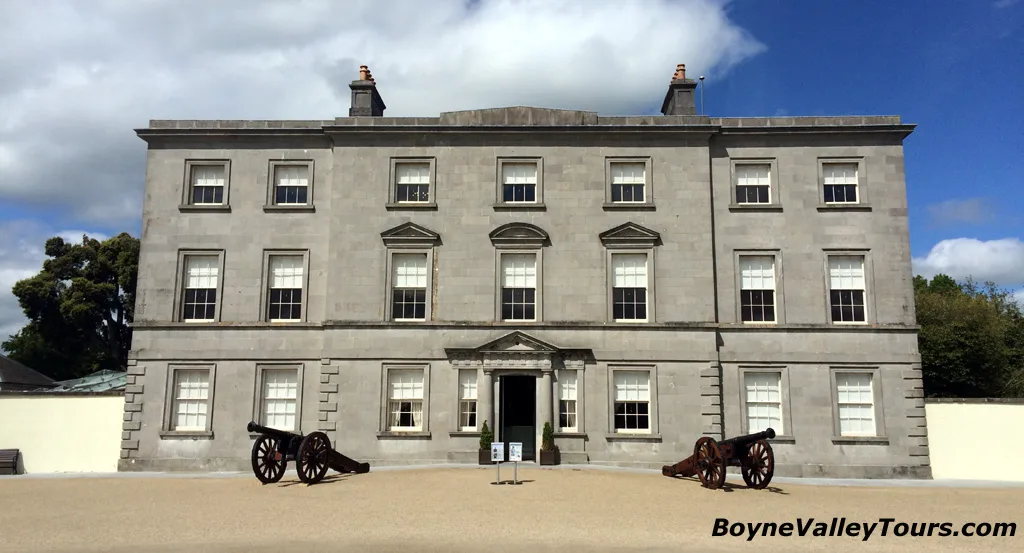
Oldbridge House at the Battle of the Boyne site
Drogheda and Slane Castle
Drogheda is the historic gateway town on the lower Boyne. St. Laurence’s Gate is one of the finest medieval barbicans in Ireland. The town also holds churches, surviving walls and Millmount above the river.
Slane Castle overlooks a bend of the Boyne west of the World Heritage tombs. Estate tours and the distillery run in season. Treat the castle as a planned add-on, not a quick extra stop.
How a private day usually runs
A full private day from Dublin usually starts with Brú na Bóinne. That block often takes about three hours, including the exhibition. Newgrange is the main OPW-guided visit. Knowth is included when it is open.
Afterwards, you can continue to the Hill of Tara and the Hill of Slane. Alternatively, you can swap those for Trim Castle, Monasterboice or Mellifont. Because this is a private tour, you can choose other listed sites instead. Two extra stops after Brú na Bóinne are realistic.
Wear shoes for grass, gravel, steps and uneven ground. At Loughcrew, expect a real hill walk rather than a chamber visit. Bring a layer. The valley is open country, so weather moves fast, and shelter at the monuments is limited.
Boyne Valley FAQ
Planning the day
How far is the Boyne Valley from Dublin?
The Boyne Valley stretches across counties Meath and Louth, about one hour north of Dublin. Your private tour includes hotel pickup in Dublin and return transport that evening.
Is hotel pickup included?
Yes. We collect you from your Dublin hotel, or from another agreed city address, and we drive throughout the day.
How long is the tour?
It is a full day. Pickup is in the morning, and you return to Dublin in the evening. Allow about three hours for Brú na Bóinne. After that, two extra stops usually fill the rest of the day without rushing.
Which three sites make the best first-time itinerary?
Newgrange, the Hill of Tara and the Hill of Slane. Knowth joins the Brú na Bóinne visit when it is open. That mix gives you a passage tomb and two historic hilltop sites close to Brú na Bóinne.
Tickets
Are attraction tickets included in the price?
No. Attraction tickets are charged separately from the tour price. We purchase the required tickets on your behalf, subject to availability, and add those admission fees during booking. Brú na Bóinne needs a reserved time. If you also want to enter the keep at Trim Castle, that guided tour has a separate admission fee. Opening hours and access can vary by season, so we confirm the latest information before we finalize the route.
What happens if Newgrange tickets are unavailable?
We reshape the day. You might visit Knowth when it is open, the Hill of Tara, Trim Castle, Monasterboice or Old Mellifont Abbey. We will not confirm a Newgrange entry until we have secured the tickets.
Do all the sites require tickets?
No. Brú na Bóinne requires advance booking. Admission charges also apply for experiences such as the guided tour of Trim Castle’s keep. Many outdoor monuments do not need an entry ticket. That includes the Hill of Tara, the Hill of Slane, Monasterboice and several abbey grounds. Seasonal visitor centers and guided tours may have separate charges.
Walking
How much walking is involved?
Expect outdoor walking on gravel paths, grass and uneven ground. Some monuments have steps. The passage at Newgrange is narrow. Loughcrew is a steeper climb, and you visit the hilltop and exterior monuments rather than the chamber. Shelter at archaeological sites is limited, so bring a waterproof jacket and an extra layer.
Can the itinerary be adjusted for mobility or personal interests?
Yes. This is a private tour, so we can customize later stops. Tell us if you prefer less walking or more time at one site. We can also follow a theme such as abbeys, quieter tombs or later history.
Lunch and other practical questions
Is there time for lunch?
Yes. We stop for lunch during the day. The tour price does not include meals.
Are tolls, fuel and parking included?
Yes. All car expenses are covered by the tour price, including tolls, fuel and parking.
What makes the Boyne Valley worth visiting?
More than 5,000 years of history sit in a relatively small region. You can see Neolithic passage tombs at Brú na Bóinne, royal hills, early Christian monasteries and Ireland’s largest Anglo-Norman castle.
Visiting the Boyne Valley with Boyne Valley Tours
Enjoy a private day from Dublin. We handle the driving, the timing and the tickets, subject to availability. The usual first-time route is Brú na Bóinne, then two more stops. Knowth is included when it is open. After that, many guests choose the Hill of Tara and the Hill of Slane. Tell us if you want less walking, more abbeys or a quieter tomb instead.

Newgrange & Boyne Valley

8hrs | €675 + Booking Fees


Boyne Valley Castles & Abbeys
8hrs | €675 + Booking Fees

Meath Megalithic Sites
8hrs | €675 + Booking Fees

Glendalough & Scenic Wicklow
8hrs | €675 + Booking Fees

Wicklow Gardens & Scenery
8hrs | €675 + Booking Fees

Cruise Excursions
8hrs | €675 + Booking Fees