Book a tour
A private Boyne Valley tour can put Old Mellifont Abbey as the medieval chapter of the day. The ruins stand in the valley of the River Mattock, about an hour north of Dublin and only a short drive from Monasterboice. We collect you from your hotel in the morning and return you that evening, so you can see Ireland’s first Cistercian monastery without driving the country roads yourself.
Many first-time visitors spend the morning at Brú na Bóinne, then continue to Mellifont as one of two extra stops later in the day. Guests who want abbeys and later history more than tombs can make Mellifont part of a Castles and Abbeys day with Trim, Bective or Monasterboice instead.
The abbey grounds are free to enter. Many Boyne Valley stops work the same way. During the main visitor season, usually from spring to early autumn, the Office of Public Works also operates a visitor center with an exhibition and guided tours for a separate admission charge. Newgrange and Knowth still need Brú na Bóinne tickets when those sites are on your day. We purchase those required tickets on your behalf, subject to availability. Time is allowed for lunch, although meals are not included in the tour price.
The visit is outdoors on paved and compacted gravel paths. A paved path from the car park provides step-free access, avoiding the flight of steps at the main entrance. Archaeological sites offer little shelter, so bring sturdy shoes and an extra layer. We can customize later stops if you prefer less walking.
What you will see at Mellifont Abbey
Today Old Mellifont Abbey is a National Monument in State Care, managed by the Office of Public Works. Most of the church and living ranges survive as foundations and low walls. Little of the great church still rises above ground, but the octagonal lavabo, the chapter house, and the spread of the cloister plan still show why Mellifont became the mother house of Cistercian Ireland. With a private guide, the ruined footprint becomes readable as a working monastery, not only a photogenic ruin.

The lavabo and cloister ruins at Old Mellifont Abbey
The valley setting and site plan
From the present entrance, you look down across the abbey’s layout in the Mattock Valley. The church stood on the north side of the complex. To the south was an open central courtyard, surrounded by covered walkways that connected the chapter house, refectory, kitchen and the lay brothers’ quarters. The surviving stone foundations, together with the site plan, make the original layout much easier to understand as you explore the ruins.

Aerial view of Old Mellifont Abbey
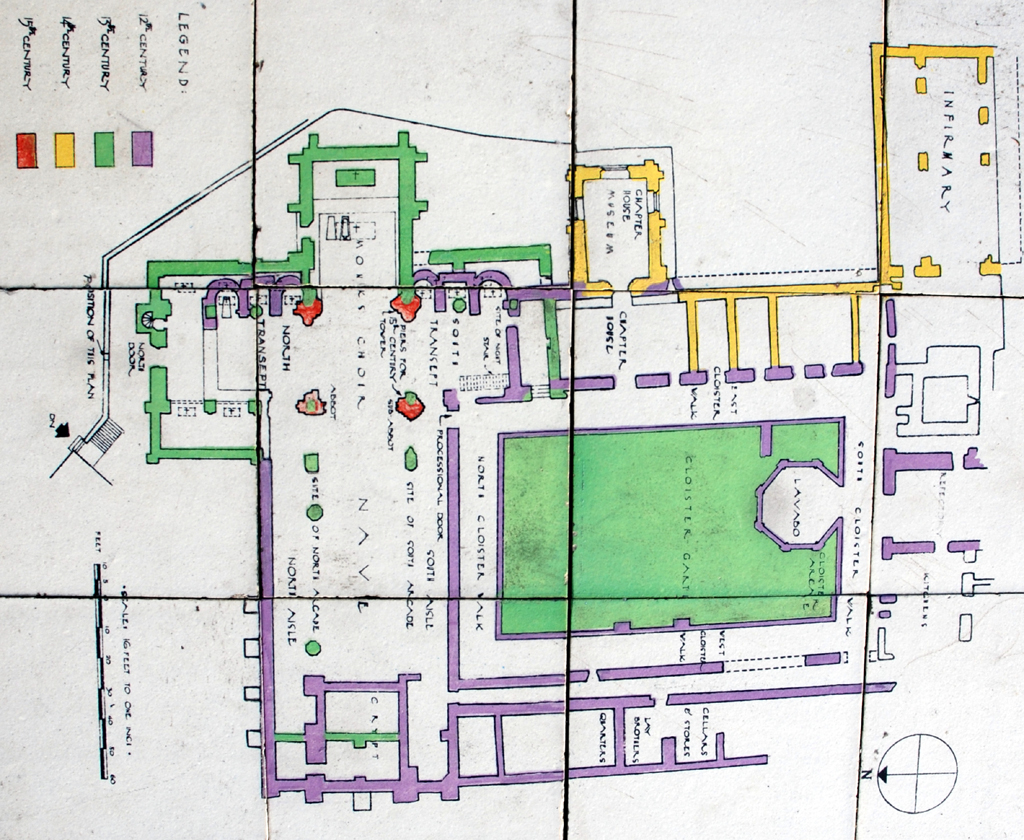
Ground plan of Mellifont Abbey
The lavabo
The abbey’s most distinctive feature is the 13th century octagonal lavabo, which stands in the central courtyard opposite the entrance to the old refectory. Before meals, the monks gathered here to wash their hands. Four arches of the original arcade still survive, making it the finest preserved medieval lavabo in Ireland. For many visitors, it is the most memorable feature of the abbey.

The octagonal lavabo at Old Mellifont Abbey
Chapter house, cloister and church remains
On the east side of the cloister stands the chapter house, where the community met. Its vaulted ceiling survives, though the once elaborate entrance arch is gone. Nearby foundations mark the bursar’s rooms, stores and the choir monks’ dormitory above. The south range held the refectory, kitchen and warming room. On the west side, low walls outline the lay brothers’ quarters. Excavation has shown repeated rebuilding from the twelfth into the fifteenth century, including remodeling of the church presbytery and transepts.
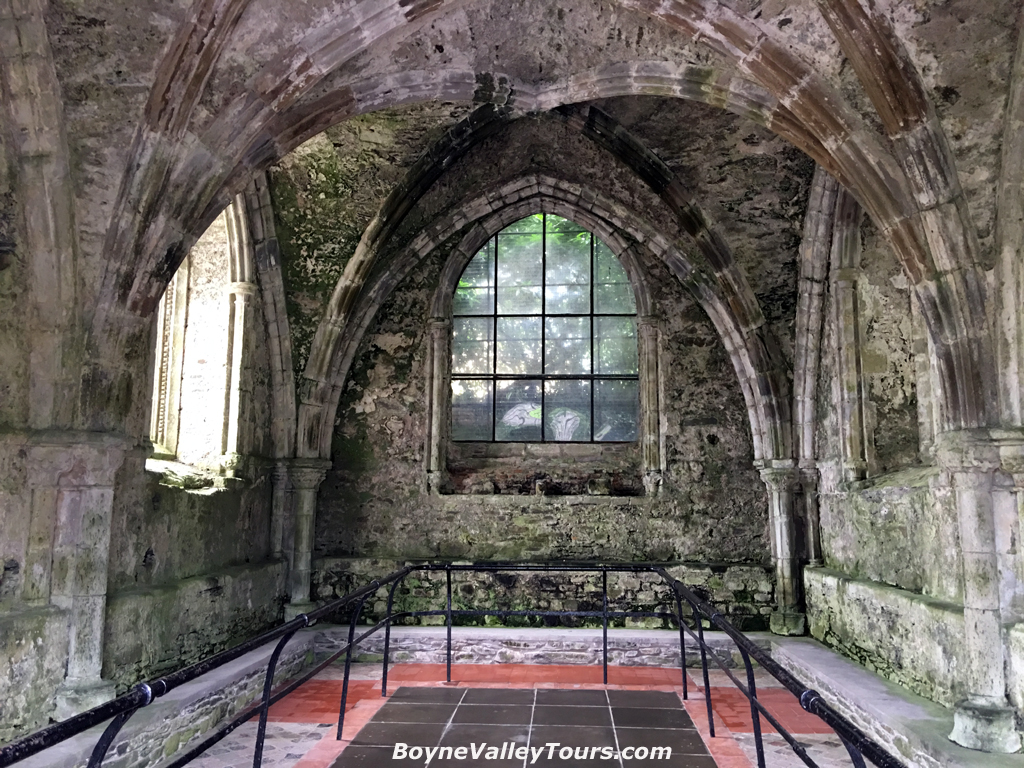
The chapter house at Old Mellifont Abbey
How a private day usually runs
A full private day from Dublin can start with Brú na Bóinne. That block often takes about three hours, including the exhibition. After that, Mellifont can be one of two extra stops, paired with Monasterboice, Trim Castle or the Battle of the Boyne at Oldbridge. The two monastic sites are less than 5 km (3 miles) apart.
Guests who want a medieval focus can skip the World Heritage tombs and spend the day on a Boyne Valley Castles and Abbeys route instead. This is a private tour, so you can choose other Boyne Valley sites instead. Two extra stops after Brú na Bóinne are realistic.
Begin by taking in the whole site from the entrance, using the site plan to get your bearings. Walk through the remains of the church, then continue to the chapter house before reaching the lavabo at the heart of the complex. From there, follow the riverside path, where interpretation panels include artists’ reconstructions showing the abbey at its medieval height.
Wear shoes for paved and gravel paths. Bring a layer. Shelter among the ruins is limited.
What Mellifont Abbey is
Old Mellifont Abbey was the first Cistercian monastery in Ireland, founded in 1142 by Saint Malachy of Armagh with help from Clairvaux in France. Irish novices trained at Clairvaux returned with French monks to begin the work. The abbey church and complex were consecrated in 1157 at a gathering that drew bishops and powerful kings.
Saint Malachy wanted a stricter continental model in Ireland: a self-contained abbey where choir monks and lay brothers lived by a shared rule, farmed their own lands, and kept the world at a distance. Local rulers backed the foundation. Donnchadh Ua Cearbhaill, king of Airgíalla (Oriel), gave land and building materials. By about 1170 Mellifont was said to have around one hundred monks and three hundred lay brothers. Daughter houses followed quickly across Ireland, including Bective Abbey on the River Boyne, founded in 1147.
Architecturally, Mellifont introduced a French Cistercian plan on a scale new to Ireland: a cruciform church, cloister walks, chapter house, refectory, dormitories and service ranges arranged as one enclosed complex. The great church once ran about 190 feet (58 meters) east to west, including the side aisles, by about 54 feet (16 meters) across.
Following the Dissolution of the Monasteries under Henry VIII in 1539, the abbey and its lands passed into private ownership. Sir Garrett Moore was living here in 1603 when Hugh O’Neill, Earl of Tyrone, submitted to the Crown at the Treaty of Mellifont, bringing the Nine Years’ War to an end. In 1690 William of Orange used Mellifont Abbey House as headquarters around the Battle of the Boyne. Much of the monastic fabric was later stripped or demolished, which is why so much of what you see today is foundation level.
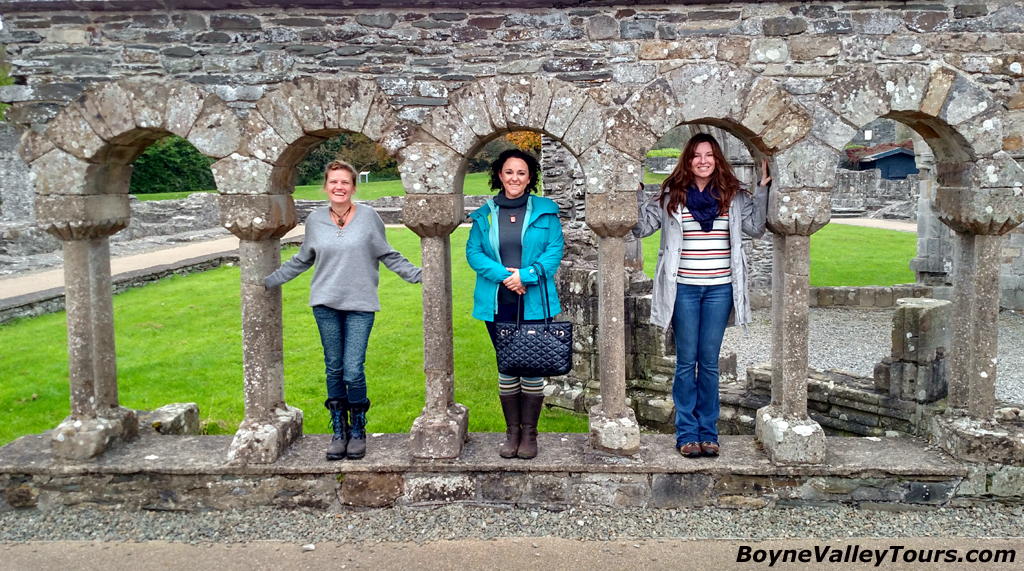
A Boyne Valley tour group at Mellifont Abbey
Mellifont Abbey FAQ
Planning the visit
How does Mellifont Abbey fit a private day from Dublin?
Mellifont is about one hour north of Dublin, just outside Tullyallen Village near Drogheda, A92 K682. Your private tour includes hotel pickup and return that evening. Mellifont often sits after Brú na Bóinne as one of two extra stops, or it can pair with Monasterboice on a Castles and Abbeys day.
How long should we allow at Mellifont Abbey?
Most visitors spend 45 minutes to an hour exploring the ruins. Allow longer if you plan to visit the seasonal exhibition or join a guided tour.
Who guides us at Mellifont Abbey?
Your private guide frames the site and the wider valley story. In season, OPW staff also run an exhibition and guided tours for a separate admission charge. The grounds remain free to walk.
Is Mellifont Abbey worth visiting if most of the buildings are ruins?
Yes. Although little of the abbey survives above ground, the layout is remarkably easy to understand. The lavabo, chapter house and surviving foundations help bring Ireland’s first Cistercian monastery back to life.
Tickets
Do we need tickets for Mellifont Abbey?
No for the grounds. The abbey grounds are free to enter. During the main visitor season, the visitor center, exhibition and guided tours require a separate admission ticket if you want that extra layer. Many outdoor Boyne Valley monuments do not need an entry ticket. Newgrange and Knowth still need reserved tickets when those sites are on your day.
Is Mellifont Abbey close to Monasterboice?
Yes. The two sites are less than 5 km (3 miles) apart, making them an easy and popular combination on the same day.
Walking
How much walking is involved?
Expect paved and compacted gravel paths. A paved path from the car park provides step-free access, avoiding the flight of steps at the main entrance. Shelter among the ruins is limited, so bring a waterproof jacket and an extra layer.
Can the day be adjusted for mobility or personal interests?
Yes. This is a private tour, so we can customize later stops. Tell us if you prefer less walking, more time at one site, or a different mix of tombs, abbeys or later history.
Lunch and other practical questions
Is there time for lunch?
Yes. We stop for lunch during the day. The tour price does not include meals. During the main season, a coffee cart is sometimes available in the car park.
Are tolls, fuel and parking included?
Yes. All car expenses are covered by the tour price, including tolls, fuel and parking.
What is the lavabo?
The lavabo is the octagonal stone structure where the monks washed their hands before meals. Mellifont’s 13th century lavabo is the finest surviving medieval example in Ireland.
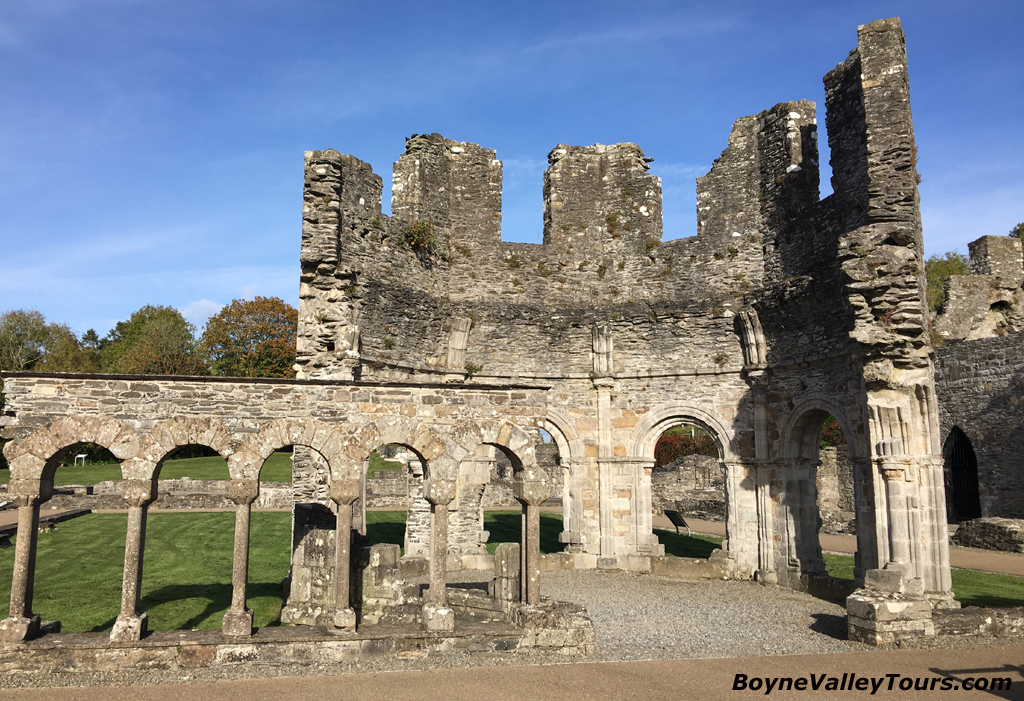
The octagonal lavabo at Old Mellifont Abbey
Visit Mellifont Abbey with Boyne Valley Tours
Enjoy a private day from Dublin. We handle the driving and the timing. The abbey grounds are free. If you want the seasonal OPW exhibition, we can add those tickets. Mellifont can follow a morning at Brú na Bóinne, or it can sit with Monasterboice, Trim Castle or Bective on a Castles and Abbeys day. Tell us if you want less walking, more tombs or a quieter stop instead. You can see the wider choice of Boyne Valley sites on the companion page.

Newgrange & Boyne Valley

8hrs | €675 + Booking Fees


Boyne Valley Castles & Abbeys
8hrs | €675 + Booking Fees

Meath Megalithic Sites
8hrs | €675 + Booking Fees

Glendalough & Scenic Wicklow
8hrs | €675 + Booking Fees

Wicklow Gardens & Scenery
8hrs | €675 + Booking Fees

Cruise Excursions
8hrs | €675 + Booking Fees