Book a tour
A private Boyne Valley tour usually includes Knowth as part of the Brú na Bóinne visit. The mounds are about an hour north of Dublin. We collect you from your hotel in the morning and return you that evening, so you can see Europe’s richest outdoor collection of megalithic art without driving or watching the clock.
Most first-time visitors spend about three hours at Brú na Bóinne, including the visitor center and the OPW-guided visits. Newgrange is the main chamber stop. When Knowth is open in the main season, it is included in that same World Heritage visit. That still leaves time for two more sites later in the day. A popular finish is the Hill of Tara and the Hill of Slane.

The Great Mound at Knowth surrounded by satellite tombs
We purchase the required Brú na Bóinne tickets on your behalf, subject to availability. Knowth tours usually run in the main season. When Knowth is closed, the Brú na Bóinne stop is Newgrange, and we reshape later stops if needed. Time is allowed for lunch, although meals are not included in the tour price.
The visit involves walking on grass paths around the Great Mound. Guests do not enter either passage. Archaeological sites offer little shelter, so bring sturdy shoes and an extra layer. We can customize later stops if you prefer less walking.
What you will see at Knowth
You start at the Brú na Bóinne Visitor Center near Donore. You do not drive up to the mound. A shuttle takes you to Knowth, and an OPW guide leads the visit on the monument itself. The strength of the stop is the outdoor circuit: the kerb ring, satellite tombs, and carved stones that photographs rarely capture at full scale. Visitors do not enter the original east and west passages. It helps to know that before you arrive.
The Great Mound and satellite tombs
The Great Mound is about 10 meters (33 feet) high and 95 meters (312 feet) across at its widest point, covering about 0.6 hectares (1.5 acres), the largest of the three great Brú na Bóinne passage tombs. Around its base runs a kerb of 127 stones. 19 smaller satellite tombs cluster around it, which shows that Knowth stayed a ceremonial focus across generations, not an isolated one-off monument.

Spring blossom at Knowth with kerbstones around the Great Mound
Kerbstones and megalithic art
Walking the perimeter is the heart of the visit. A far greater share of Knowth’s kerbstones carry heavy carving than at Newgrange. Spirals, lozenges, chevrons, zigzags and arcs cover kerb and chamber stones. Some faces are dense with motifs. Others only resolve when the light is right. That outdoor art trail is something Newgrange cannot match in the same way.
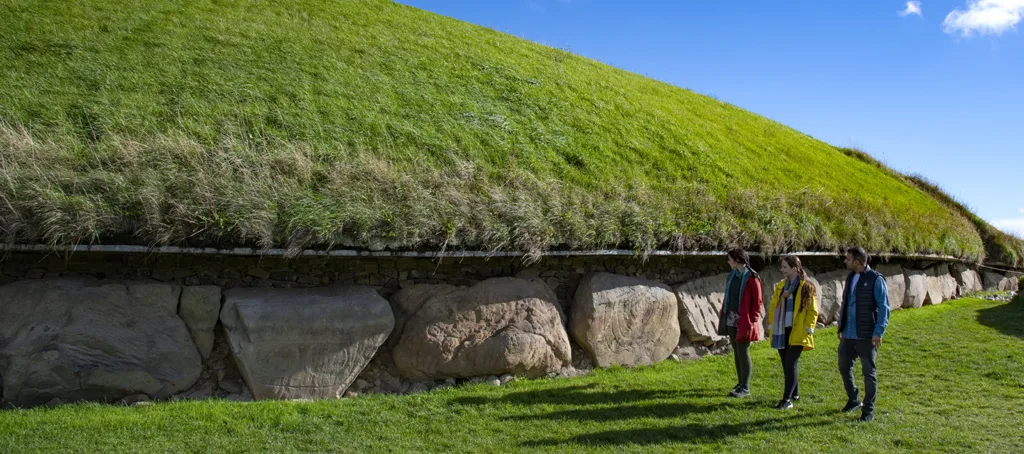
Decorated kerbstones ringing the Great Mound at Knowth

Knowth Kerbstone 5 (K5) with spiral and concentric carvings
Twin passages, chambers and stone basins
Knowth contains two independent passage tombs within the same mound, aligned broadly east and west. The eastern passage and chamber together extend over 40 meters (131 feet), while the western passage and chamber extend over 34 meters (112 feet). Each passage leads to its own chamber, with stone basins used in burial rituals. Visitors can view the entrances, kerbstones and quartz settings from outside but do not enter the passages or chambers.

The western passage entrance at Knowth with its bed of white quartz

The carved stone basin in Knowth’s eastern chamber
How a private day usually runs
A full private day from Dublin usually starts with Brú na Bóinne. That block often takes about three hours, including the exhibition. Newgrange is the main OPW-guided chamber visit. Knowth is included when it is open.
After the World Heritage visit, you can continue to the Hill of Tara and the Hill of Slane, or swap those for Trim Castle, Monasterboice or Mellifont. This is a private tour, so you can choose other Boyne Valley sites instead. Two extra stops after Brú na Bóinne are realistic.
Wear shoes for grass, gravel, steps and uneven ground. Bring a layer. The valley is open country, weather moves fast, and shelter at the monuments is limited. Automated External Defibrillators (AEDs) are available at the Visitor Center, at Knowth and at Newgrange.
What Knowth is
Knowth is a ceremonial and funerary complex rather than a single tomb. Builders raised it around 3200 BC, contemporary with Newgrange and older than Stonehenge. UNESCO inscribed Brú na Bóinne as a World Heritage Site in 1993. Knowth holds the largest concentration of megalithic art in Western Europe. Many carvings sit low around the mound or were partly concealed, which suggests they belonged to a restricted visual language rather than a public gallery.
Excavations led by Professor George Eogan began in 1962 and continued for several decades. They recovered cremated and unburnt human remains, stone basins, worked flint and other objects. Knowth was then reused for thousands of years: Bronze Age burial, early medieval settlement with houses and souterrains, and later remodeling of the summit during the Anglo-Norman period, probably for defensive purposes.
Unlike Newgrange, Knowth is not aligned to a dramatic winter solstice beam. Its twin passages invited equinox assumptions, but research by Frank Prendergast and Tom Ray, published in the Royal Irish Academy Knowth series, shows that neither passage matches equinox sunrise or sunset once true north and the local horizon are taken into account. Later alteration of the entrances also means any original lighting effect cannot now be observed with certainty.
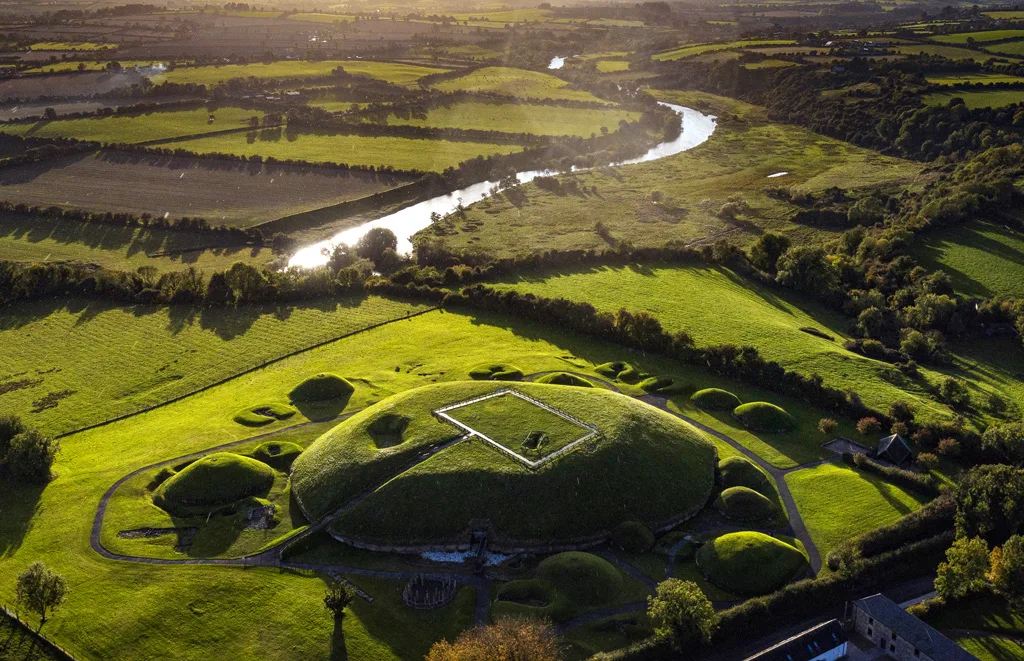
Knowth with the River Boyne beyond the fields
Knowth FAQ
Planning the visit
How does Knowth fit a private day from Dublin?
The Boyne Valley is about one hour north of Dublin. Your private tour includes hotel pickup and return that evening. Knowth is usually part of the Brú na Bóinne block when it is open, together with Newgrange. After that, two extra stops usually fill the rest of the day without rushing.
How long should we allow at Knowth?
A visit to Knowth alone is typically about 2 hours including the visitor center. If you are visiting Newgrange and Knowth together, allow about 3 hours in total including time at the visitor center.
Who guides us at Knowth?
OPW guides lead the onsite tour at Knowth. Boyne Valley Tours coordinates your day, the driving and the tickets. The official World Heritage tour continues with the OPW team on the monument. Your private guide frames the valley story before and after.
Can we go inside the passages?
No. Visitors do not enter Knowth’s east or west passages. You still see the entrances from outside, along with the kerbs, satellite tombs and the full outdoor art circuit. Confirm the exact OPW program when your day is booked.
Tickets
Are Knowth tickets included in the tour price?
No. Attraction tickets are charged separately. We purchase the required Brú na Bóinne tickets on your behalf, subject to availability, and add those admission fees during booking. Knowth is seasonal. Opening hours and access can vary, so we confirm the latest information before we finalize the route.
What happens if Knowth is closed?
The Brú na Bóinne stop is Newgrange. We reshape later stops if you still want a quieter tomb, an abbey or more time at Tara.
Is Knowth worth it if we are already visiting Newgrange?
Yes, especially if you care about megalithic art and site layout. Most of Knowth’s story is readable outdoors on the kerbstones.
Do later stops also need tickets?
Not always. Many outdoor Boyne Valley monuments do not need an entry ticket. That includes the Hill of Tara, the Hill of Slane, Monasterboice and several abbey grounds. Trim Castle’s grounds are free. The keep tour there has a separate admission if you want to go inside.
Walking
How much walking is involved?
Expect outdoor walking on grass and paths around the Great Mound. The kerb circuit is the heart of the visit. Shelter at the monument is limited, so bring a waterproof jacket and an extra layer.
Can the day be adjusted for mobility or personal interests?
Yes. This is a private tour, so we can customize later stops. Tell us if you prefer less walking, more time at one site, or a different mix of tombs, abbeys or later history.
Lunch and other practical questions
Is there time for lunch?
Yes. We stop for lunch during the day. The tour price does not include meals.
Are tolls, fuel and parking included?
Yes. All car expenses are covered by the tour price, including tolls, fuel and parking.
Is it aligned like Newgrange at the solstice?
No. Knowth is not a winter solstice monument in the Newgrange sense. The east and west passages invited equinox assumptions, but later research indicates they are not aligned to the equinoxes.
Visit Knowth with Boyne Valley Tours
Enjoy a private day from Dublin. We handle the driving, the timing and the Brú na Bóinne tickets, subject to availability. Later stops such as Tara and the Hill of Slane usually do not need an entry ticket. The usual first-time route starts at Brú na Bóinne, with Newgrange as the main OPW-guided visit and Knowth included when it is open. Tell us if you want less walking, more abbeys or a quieter tomb instead. You can see the wider choice of Boyne Valley sites on the companion page.

Newgrange & Boyne Valley

8hrs | €700 + Booking Fees


Boyne Valley Castles & Abbeys
8hrs | €700 + Booking Fees

Meath Megalithic Sites
8hrs | €700 + Booking Fees

Glendalough & Scenic Wicklow
8hrs | €700 + Booking Fees

Wicklow Gardens & Scenery
8hrs | €700 + Booking Fees

Cruise Excursions
8hrs | €700 + Booking Fees