Book a tour
Brú na Bóinne is home to the ancient passage tombs of Newgrange, Knowth and Dowth. This UNESCO World Heritage landscape offers a chance to explore Ireland’s distant past, about an hour north of Dublin.

The Great Mound at Knowth surrounded by satellite tombs
UNESCO inscribed the property in 1993 as Brú na Bóinne – Archaeological Ensemble of the Bend of the Boyne. The name is usually translated as the palace or mansion of the Boyne. The listing is not a single mound. It is a funerary landscape of great ritual significance, dominated by Newgrange, Knowth and Dowth, with about forty smaller passage tombs around them. The monuments had social, economic, religious and funerary roles. Later Iron Age, early Christian and medieval sites sit in the same fields.
Most first-time visitors spend about three hours at Brú na Bóinne, including the visitor center and the OPW-guided visits. Newgrange is the main chamber stop. When Knowth is open, it is included in that same World Heritage visit. Dowth is a separate roadside stop, and its exterior is generally free. We purchase the required Brú na Bóinne tickets for Newgrange and Knowth on your behalf, subject to availability. Time is allowed for lunch, although meals are not included in the tour price.
What UNESCO recognized
The World Heritage property covers about 780 hectares (1,930 acres) of ridge, floodplain and farmland between the Boyne and the Mattock, about 40 kilometers (25 miles) north of Dublin. The three great mounds stand on the north bank of the Boyne. Besides those tombs, some 90 monuments are recorded across the property, with more still unrecorded. A buffer of about 2,500 hectares (6,180 acres) protects mapped views into and out of the landscape. The listing treats the bend of the Boyne as one archaeological ensemble, not three isolated visitor attractions.

Newgrange’s Kerbstone 52, positioned directly opposite Kerbstone 1 at the entrance to the passage tomb.
UNESCO listed the site for three reasons, written in visitor language rather than committee shorthand. The carved stones at Brú na Bóinne are the largest and most important body of prehistoric megalithic art in Europe. The valley holds an unusual concentration of social, economic and funerary monuments at one ritual center, with use stretching from prehistory into the later Middle Ages. The passage tomb itself, here brought to its finest expression, was a feature of outstanding importance in prehistoric Europe.
The place is still farmland, and archaeologists have been working here for more than a hundred years. Views into and out of the property are part of what the listing protects. The landscape is also part of an area rich in stories of Ireland’s ancient past, remembered in Irish tradition as Brú na Bóinne, a supernatural dwelling on the Boyne.
The Knowth, Newgrange and Dowth groups
UNESCO describes three clusters, not only three famous mounds.
The Knowth group has the longest recorded span of use, from the Neolithic through to the Anglo-Norman period. The official inventory lists about thirty monuments and sites there: passage tombs with carved stones, enclosures, occupation sites and field systems. That is why a Knowth visit still reads as a lived landscape, not a single tomb.

Spring blossom at Knowth with kerbstones around the Great Mound
The Newgrange group is prehistoric. Beside the great mound sit other passage tombs, a henge, a cursus and a ringfort. You come for the chamber and the roof-box. The listing also treats the surrounding ritual ground as part of the same story.
The Dowth group is similar in outline, with later medieval evidence in the form of a church and a castle. Earthworks such as Dowth Henge show that this corner of the bend kept drawing people long after the great mound was raised.

Dowth Henge in the surrounding Boyne Valley landscape
How the property is protected and visited
Most of the 780 hectares remain in private ownership. The Office of Public Works manages the State-owned ground around Newgrange and Knowth. The Brú na Bóinne Visitor Center opened in June 1997. Its main job is to control the number of people reaching those two mounds. Daily numbers are limited, and access to Newgrange and Knowth is by guided tour only.
What you see at the restored tombs is authentic archaeology, presented after excavation and conservation. At Newgrange, the kerbstones were reset and the passage was rebuilt so visitors can still enter safely. At Knowth, structures from many periods are conserved, and later support work is meant to read as modern where it is visible. The quartz face, the outdoor paths and the visitor-center shuttle are part of that managed presentation. They are not the whole World Heritage property.
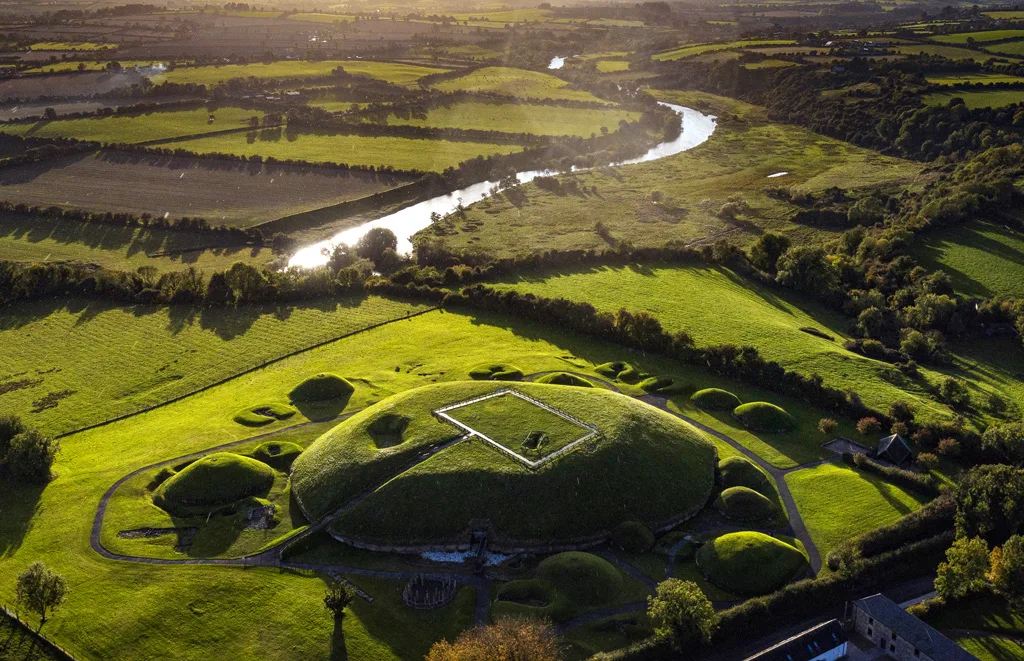
Knowth with the River Boyne beyond the fields
The three great mounds
You start at the Brú na Bóinne Visitor Center near Donore. You do not drive up to Newgrange or Knowth. A shuttle takes you to those monuments, and OPW guides lead the visits on site. Dowth is reached separately by road. It helps to know the access differences before you arrive.
Newgrange
Newgrange is the best-known monument in the ensemble. Builders raised the mound around 3200 BC. Guests do enter the passage and chamber on the standard OPW tour. The roof-box above the entrance can send winter solstice sunrise down the 19-meter (62-foot) passage when the sky is clear. The passage is low and narrow in places.
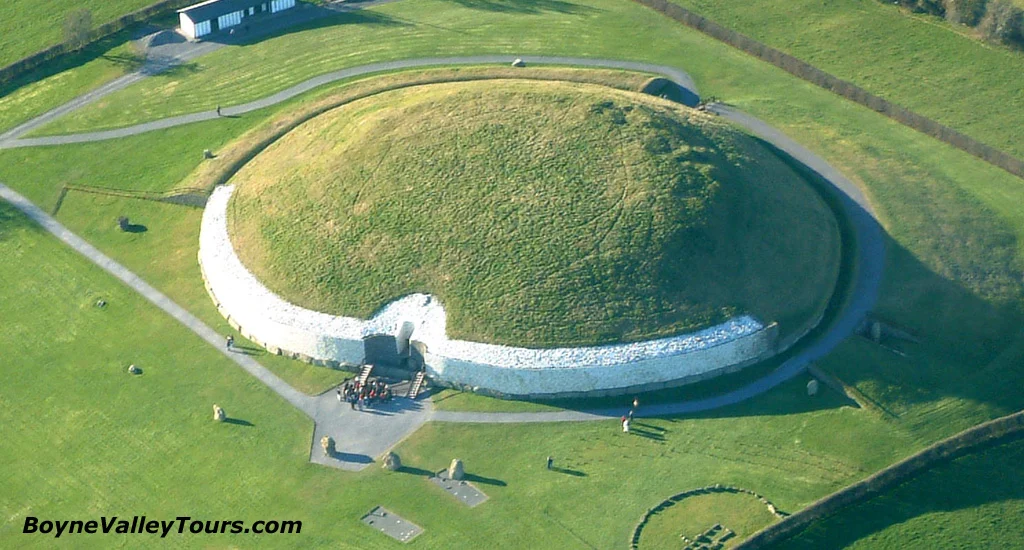
The Newgrange mound in the Boyne Valley

Entrance to the Newgrange passage tomb with kerbstones and white quartz lined roof-box
Knowth
Knowth is the largest of the three great mounds, with satellite tombs clustered around it. The strength of the stop is the outdoor circuit: kerbstones, carved stones and the layout of the complex. Visitors do not enter either passage. Knowth tours usually run in the main season. When Knowth is closed, the Brú na Bóinne stop is Newgrange.
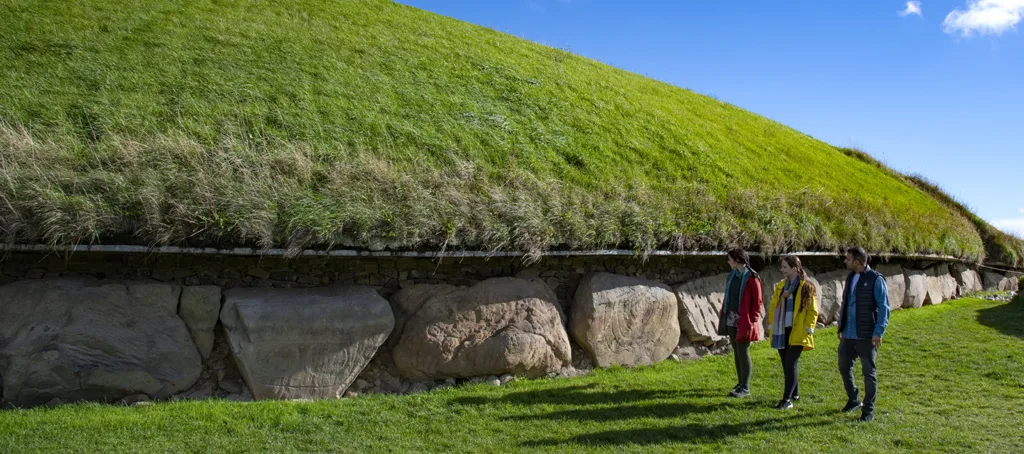
Decorated kerbstones ringing the Great Mound at Knowth

The western passage entrance at Knowth with its bed of white quartz
Dowth
Dowth completes the trio. It is quieter, less restored, and not on the visitor-center shuttle. The exterior is generally free to visit. Visitors do not enter the passages or chambers on a standard day. Two tombs open on the western side of the mound, and Dowth South is linked with winter solstice sunset rather than Newgrange’s famous sunrise.

Aerial view of the 5,200-year-old passage tomb at Dowth at sunrise.

Kerbstone 51 at Dowth, the so-called Stone of the Seven Suns
How a private day usually runs
A full private day from Dublin usually starts with the World Heritage visit. That block often takes about three hours, including the exhibition. Newgrange is the main OPW-guided chamber visit. Knowth is included when it is open.
After that, many guests add Dowth as a quieter outdoor stop, or continue to the Hill of Tara and the Hill of Slane. This is a private tour, so you can choose other Boyne Valley sites instead. Two extra stops after Brú na Bóinne are realistic.
Wear shoes for grass, gravel, steps and uneven ground. Bring a layer. The valley is open country, weather moves fast, and shelter at the monuments is limited. Automated External Defibrillators (AEDs) are available at the Visitor Center, at Knowth and at Newgrange.
UNESCO Brú na Bóinne FAQ
Planning the visit
What is Brú na Bóinne?
It is the archaeological ensemble in a bend of the River Boyne in County Meath. The Irish name is usually translated as the palace or mansion of the Boyne. UNESCO listed it in 1993 as a World Heritage Site. The three great passage tombs are Newgrange, Knowth and Dowth, with many smaller monuments around them.
What else is in the World Heritage property besides the three mounds?
UNESCO treats three clusters. The Knowth group includes about thirty recorded sites, from carved passage tombs to later settlement. The Newgrange group is prehistoric, with a henge, a cursus and other tombs around the main mound. The Dowth group includes later medieval remains and earthworks such as Dowth Henge. Across the whole property, about 90 monuments are recorded, plus others still unrecorded.
How does the World Heritage visit fit a private day from Dublin?
The Boyne Valley is about one hour north of Dublin. Your private tour includes hotel pickup and return that evening. Brú na Bóinne is usually the first major stop, as part of about three hours at the visitor center and the mounds. After that, two extra stops usually fill the rest of the day without rushing.
Can we visit all three great mounds in one day?
Yes, if timing allows. Newgrange and Knowth use the visitor-center shuttle when Knowth is open. Dowth is a separate roadside stop. Many first-time visitors do Newgrange and Knowth, then add Tara and Slane. Dowth is a strong extra if you want the full trio.
Tickets
Do we need tickets for Brú na Bóinne?
Yes for Newgrange and Knowth. Those visits start at the visitor center and need reserved tickets. We purchase them on your behalf, subject to availability. Dowth’s exterior is generally free. Many later Boyne Valley stops, such as the Hill of Tara and the Hill of Slane, also do not need an entry ticket.
Are attraction tickets included in the tour price?
No. Attraction tickets are charged separately. We add the required Brú na Bóinne admission fees during booking. If Newgrange tickets are unavailable, we reshape the day around other rewarding sites.
Walking
How much walking is involved?
Expect outdoor walking on gravel paths, grass and uneven ground. The passage at Newgrange is narrow. Guests do not enter Knowth’s passages or Dowth’s chambers on a standard visit. Shelter at the monuments is limited, so bring a waterproof jacket and an extra layer.
Can the day be adjusted for mobility or personal interests?
Yes. This is a private tour, so we can customize later stops. Tell us if you prefer less walking, more time at one site, or a different mix of tombs, abbeys or later history.
Lunch and other practical questions
Is there time for lunch?
Yes. We stop for lunch during the day. The tour price does not include meals.
Are tolls, fuel and parking included?
Yes. All car expenses are covered by the tour price, including tolls, fuel and parking.
Why is it called a World Heritage Site?
UNESCO listed Brú na Bóinne for its megalithic art, the density of monuments at one ritual center, and the quality of the passage tombs. The listing covers the landscape in the bend of the Boyne, not only the restored facade at Newgrange.
Why are Newgrange and Knowth guided tours only?
The visitor center opened in 1997 to protect the mounds and manage daily numbers. Access to Newgrange and Knowth is by OPW guided tour. That limit is part of how the World Heritage property is looked after.
Visit UNESCO Brú na Bóinne with Boyne Valley Tours
Enjoy a private day from Dublin. We handle the driving, the timing and the Brú na Bóinne tickets, subject to availability. The usual first-time route starts at the World Heritage visitor center, with Newgrange as the main OPW-guided visit and Knowth included when it is open. After that, many guests choose Tara, Slane or a quieter stop at Dowth. Tell us if you want less walking, more abbeys or a quieter tomb instead. You can see the wider choice of Boyne Valley sites on the companion page.

Newgrange & Boyne Valley

8hrs | €675 + Booking Fees


Boyne Valley Castles & Abbeys
8hrs | €675 + Booking Fees

Meath Megalithic Sites
8hrs | €675 + Booking Fees

Glendalough & Scenic Wicklow
8hrs | €675 + Booking Fees

Wicklow Gardens & Scenery
8hrs | €675 + Booking Fees

Cruise Excursions
8hrs | €675 + Booking Fees