Book a tour
A private Boyne Valley tour usually puts Newgrange at the heart of the day. The mound is about an hour north of Dublin. We collect you from your hotel in the morning and return you that evening, so you can see Ireland’s most famous passage tomb without driving or watching the clock.
Most first-time visitors spend about three hours at Brú na Bóinne, including the visitor center and the OPW-guided visit. Newgrange is the main stop. When Knowth is open, it is included in that same World Heritage visit. That still leaves time for two more sites later in the day. A popular finish is the Hill of Tara and the Hill of Slane.
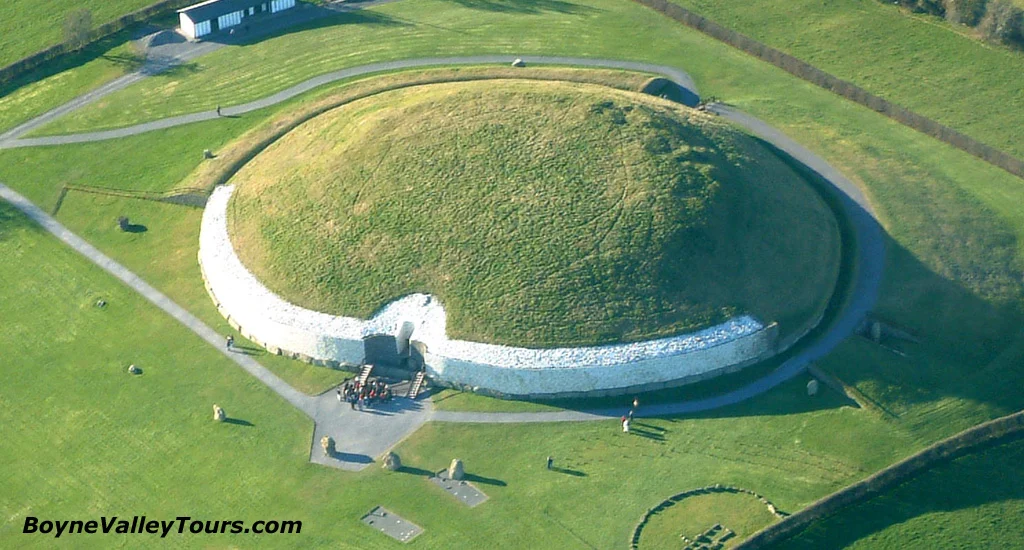
The Newgrange mound in the Boyne Valley
We purchase the required Brú na Bóinne tickets on your behalf, subject to availability. Newgrange needs a reserved time. If tickets are sold out, we reshape the itinerary around other rewarding sites such as Fourknocks, Tara, Trim Castle or one of the valley’s historic abbeys. Time is allowed for lunch, although meals are not included in the tour price.
The visit involves walking on gravel paths, grass and uneven ground. The passage at Newgrange is low and narrow in places and may not suit guests with claustrophobia or limited mobility. Archaeological sites offer little shelter, so bring sturdy shoes and an extra layer. We can customize later stops if you prefer less walking.
What you will see at Newgrange
You start at the Brú na Bóinne Visitor Center near Donore. You do not drive up to the mound. A shuttle takes you across the Boyne, and an OPW guide leads the visit on the monument itself. You walk the exterior, see the quartz facade and kerbstones, then enter the passage and chamber on the standard tour. Capacity is limited, which is why timing and tickets matter.
When Knowth is open in the main season, the OPW-guided visit from the visitor center includes it with Newgrange. When Knowth is closed, the Brú na Bóinne stop is Newgrange.
The mound, quartz facade and kerbstones
From outside, Newgrange reads as a restored circular mound about 85 meters (279 feet) across and 13 meters (43 feet) high. Near the entrance, a white quartz face stands out against darker rounded cobbles. Ninety-seven kerbstones ring the base, some carved with megalithic art. The entrance stone, Kerbstone 1 (K1), is the most famous. Carvers cut spirals into it before the mound was finished, and later cairn material partly covered the stone.

Entrance to the Newgrange passage tomb with kerbstones and white quartz lined roof-box

Newgrange Kerbstone 1 (K1), the carved entrance stone
The roof-box, passage and chamber
The roof-box above the doorway is the architectural key to the winter solstice event. Inside, a 19-meter (62-foot) passage leads to a chamber with three recesses beneath a corbelled roof that has kept the interior largely dry for millennia. Guests do enter the passage and chamber on the standard OPW tour. The passage is confined, so follow the guide’s instructions on photography and group size.

The roof-box above the Newgrange entrance
Winter solstice light
Around 21 December, sunrise can send a narrow beam through the roof-box into the chamber. The effect lasts about 17 minutes and depends on clear skies. A free solstice lottery allocates those dawn places inside the chamber. Visitors can still gather outside on solstice mornings. On a private Boyne Valley day at other times of year, the OPW tour still takes you into the chamber, where the guide explains the alignment even without the live sunbeam.
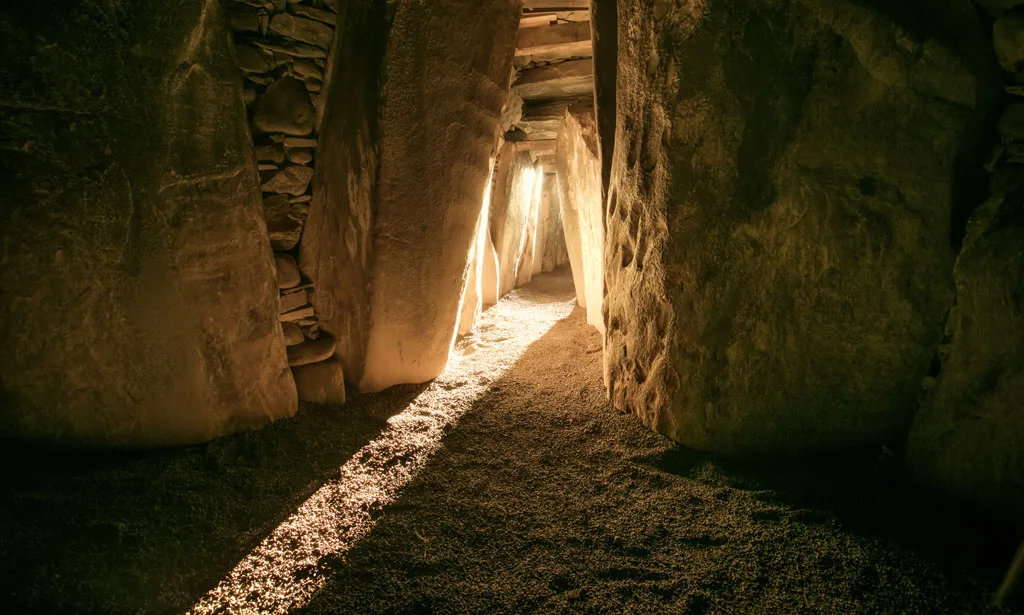
Winter solstice sunlight in the Newgrange passage
How a private day usually runs
A full private day from Dublin usually starts with Brú na Bóinne. That block often takes about three hours, including the exhibition. Newgrange is the main OPW-guided visit. Knowth is included when it is open.
After the World Heritage visit, you can continue to the Hill of Tara and the Hill of Slane, or swap those for Trim Castle, Monasterboice or Mellifont. This is a private tour, so you can choose other Boyne Valley sites instead. Two extra stops after Brú na Bóinne are realistic.
Wear shoes for grass, gravel, steps and uneven ground. Bring a layer. The valley is open country, weather moves fast, and shelter at the monuments is limited. Automated External Defibrillators (AEDs) are available at the Visitor Center, at Knowth and at Newgrange.
What Newgrange is
Think of Newgrange as a ceremonial and funerary monument rather than a simple burial mound. Builders raised it around 3200 BC, older than Stonehenge and the Great Pyramids of Giza. Stone basins in the chamber held cremated human remains. The architecture links ritual practice with burial, and UNESCO inscribed Brú na Bóinne as a World Heritage Site in 1993.
Estimates put the mound at about 200,000 tons of stone and earth, covering more than an acre. Much of the cairn material came from local Boyne river terraces, while structural slabs and decorative cobbles arrived from farther afield. White quartz is linked with the Wicklow Mountains about 50 kilometers (30 miles) to the south. Dark cobbles are linked with the Mournes about 50 kilometers (30 miles) to the north. Greywacke kerb and passage stones are often connected with coastal sources such as Clogherhead in County Louth, about 20 kilometers (12 miles) away.
People rediscovered the chamber in the late seventeenth century. In the 1960s, Professor Michael J. O’Kelly led the excavations that still shape what visitors see. On 21 December 1967, O’Kelly and his team were among the first in modern times to witness the solstice light inside the chamber.
In Irish tradition the Boyne monuments are remembered as Brú na Bóinne, a supernatural dwelling linked with figures such as Boann, the Dagda and Aengus Óg. Those stories were written long after the Neolithic, though they show how strongly the mound held later imagination. For visitors, the myths are a reminder that Newgrange has always been more than engineering.

The back of the Newgrange mound, directly opposite the chamber entrance
Newgrange FAQ
Planning the visit
How does Newgrange fit a private day from Dublin?
The Boyne Valley is about one hour north of Dublin. Your private tour includes hotel pickup and return that evening. Newgrange is usually the first major stop, as part of about three hours at Brú na Bóinne. After that, two extra stops usually fill the rest of the day without rushing.
How long should we allow at Newgrange?
A visit to Newgrange alone is typically about 2 hours including the visitor center. If Knowth is open and included, allow about 3 hours in total including time at the visitor center.
Who guides us at Newgrange?
OPW guides lead the onsite tour at Newgrange. Boyne Valley Tours coordinates your day, the driving and the tickets. The official World Heritage tour continues with the OPW team on the monument. Your private guide frames the valley story before and after.
Can we go inside?
Yes. The standard OPW visit includes entry to the passage and chamber, subject to tickets, group size and any operational limits on the day. The passage is low and narrow in places. Confirm details when your day is booked.
Tickets
Are Newgrange tickets included in the tour price?
No. Attraction tickets are charged separately. We purchase the required Brú na Bóinne tickets on your behalf, subject to availability, and add those admission fees during booking. Newgrange needs a reserved time. Opening hours and access can vary by season, so we confirm the latest information before we finalize the route.
What happens if Newgrange tickets are unavailable?
We reshape the day. You might visit Knowth when it is open, the Hill of Tara, Trim Castle, Monasterboice or Old Mellifont Abbey. We will not confirm a Newgrange entry until we have secured the tickets.
Is Newgrange worth visiting if we cannot be there at the solstice?
Yes. The OPW tour still takes you into the passage and chamber, and the guide explains the alignment. Many visitors experience Newgrange outside the lottery mornings and still find it one of the strongest stops in Ireland.
Walking
How much walking is involved?
Expect outdoor walking on gravel paths, grass and uneven ground. The passage at Newgrange is narrow. Shelter at the monument is limited, so bring a waterproof jacket and an extra layer.
Can the day be adjusted for mobility or personal interests?
Yes. This is a private tour, so we can customize later stops. Tell us if you prefer less walking, more time at one site, or a different mix of tombs, abbeys or later history.
Lunch and other practical questions
Is there time for lunch?
Yes. We stop for lunch during the day. The tour price does not include meals.
Are tolls, fuel and parking included?
Yes. All car expenses are covered by the tour price, including tolls, fuel and parking.
What is the roof-box?
It is the opening above the entrance. Around 21 December, when the sky is clear, it channels winter solstice sunrise into the passage and chamber for about 17 minutes.
Visit Newgrange with Boyne Valley Tours
Enjoy a private day from Dublin. We handle the driving, the timing and the tickets, subject to availability. The usual first-time route starts at Brú na Bóinne, with Newgrange as the main OPW-guided visit and Knowth included when it is open. After that, many guests choose the Hill of Tara and the Hill of Slane. Tell us if you want less walking, more abbeys or a quieter tomb instead. You can see the wider choice of Boyne Valley sites on the companion page.

Newgrange & Boyne Valley

8hrs | €675 + Booking Fees


Boyne Valley Castles & Abbeys
8hrs | €675 + Booking Fees

Meath Megalithic Sites
8hrs | €675 + Booking Fees

Glendalough & Scenic Wicklow
8hrs | €675 + Booking Fees

Wicklow Gardens & Scenery
8hrs | €675 + Booking Fees

Cruise Excursions
8hrs | €675 + Booking Fees