Book a tour
Visiting Ireland’s Ancient East often starts with a private day in the Boyne Valley. Newgrange is about an hour north of Dublin. We collect you from your hotel in the morning and return you that evening, so you can see the best-known passage tomb in that historic east without driving or watching the clock.
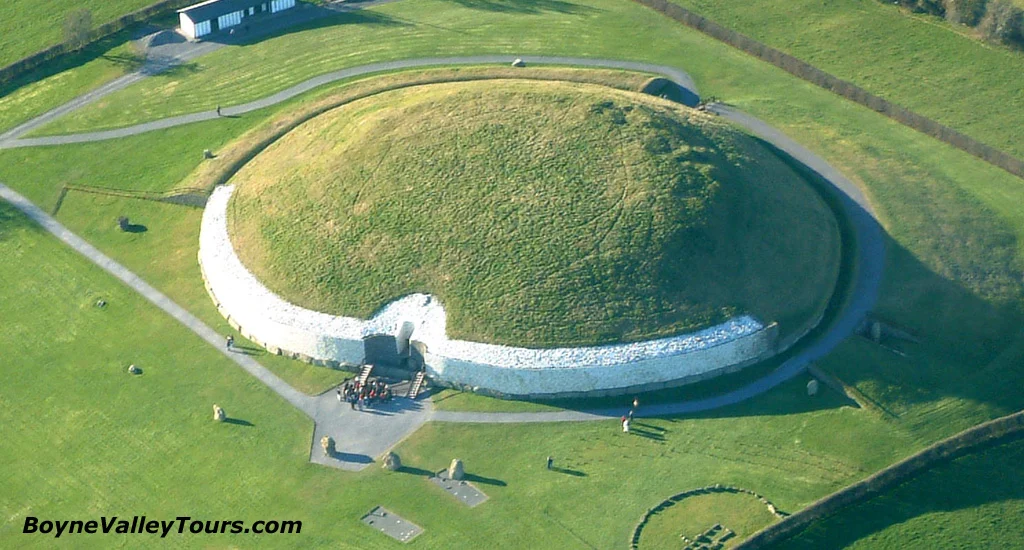
Newgrange is a Stone Age monument in Ireland’s Ancient East
Most first-time visitors spend about three hours at Brú na Bóinne, including the visitor center and the OPW-guided visits. Newgrange is the main chamber stop. When Knowth is open, it is included in that same World Heritage visit. That still leaves time for two more sites later in the day. A popular finish is the Hill of Tara and the Hill of Slane.
Newgrange needs a reserved Brú na Bóinne ticket. We purchase those required tickets on your behalf, subject to availability. Many nearby Ancient East stops do not need an entry ticket. That includes the Hill of Tara, the Hill of Slane, Monasterboice and several abbey grounds. If Newgrange is sold out, we reshape the itinerary around other rewarding sites. Time is allowed for lunch, although meals are not included in the tour price.
The visit involves walking on gravel paths, grass and uneven ground. Guests do enter the passage and chamber on the standard OPW tour. The passage is low and narrow in places. Archaeological sites offer little shelter, so bring sturdy shoes and an extra layer.
The heart of Ireland’s Ancient East
Newgrange stands in County Meath, near the Louth border and the town of Drogheda. Builders raised it around 3200 BC, older than Stonehenge and older than the Great Pyramids of Giza. A roof-box over the entrance can send sunrise down the 62-foot (19-meter) passage at winter solstice. The beam then reaches the chamber.
You start at the Brú na Bóinne Visitor Center near Donore. You do not drive up to the mound. A shuttle takes you across the Boyne, and an OPW guide leads the visit on the monument itself. UNESCO listed Brú na Bóinne as a World Heritage Site in 1993. For a full site briefing, see Visiting Newgrange.

Sheep at Newgrange Megalithic Passage Tomb
What you can see at Newgrange
On a standard tour, visitors do enter the passage and chamber. A light show also explains the midwinter sun. Carbon dating places the build around 3200 BC. Most researchers see a ritual role. The winter solstice beam is part of that debate. Some link it to death rites. Others point to the turning of the year.
Excavators found human remains, both burnt and unburnt. The unburnt bones came from at least two people. No complete skeletons were in the tomb. Offerings included marbles, pendants, and beads. Looters likely took more over the centuries.
Newgrange is a cairn. Builders stacked stone to raise the mound. Most of the large stones are greywacke from Clogherhead, north of Drogheda in County Louth. Granite also came from the north shore of Dundalk Bay. The white quartz facade came from the Wicklow Mountains. In all, they moved about 200,000 tons of material.
The interior is cruciform. A 62-foot (19-meter) passage ends in three small recesses. Each recess has a basin stone. People left remains and offerings there.

Newgrange Entrance Stone K1
Megalithic art covers many stones. The most famous carving is the triple spiral, or triskele. Some see it as decoration. Others link it to the sun. No one can prove the original meaning.
“This was a special trip for my mother-in-law to visit Ireland and see where her ancestors emigrated from. Michael picked us up from the airport right on time and drove us around the Boyne Valley, stopping at the Hill of Tara, Hill of Slane, and Knowth and Newgrange. He was very knowledgable on the local area. After the tour he dropped us off at our hotel in Dublin. This was one of the best days of our trip! I would definitely hire Michael again!” Trip Advisor Review
Stories grew around the mound for centuries. In Irish legend, passage tombs could open to the otherworld, or to the realm of the Tuatha De Danann. Those tales may post-date the builders. Still, they show how later people read the site. For more of that landscape, see the Boyne Valley mythological landscape.
One famous story names the Dagda, a leading Irish god. He sent the druid Elcmar on an errand, then spent time with Elcmar’s wife, the goddess of the River Boyne. A child was born. The Dagda held the sun still for nine months. Time stopped everywhere except inside Newgrange. Elcmar then believed the child was his.
“Our tour with Michael was absolutely one of the best experiences in a long tour of Europe. Visitng Newgrange and another passage tomb, and the Hill of Tara were goals for our time in Ireland: we were very satisfied. And Michaelʻs knowledge of early Irish history and ability to talk about it were a true gift.” Trip Advisor Review
Winter solstice sunrise
On mornings around 21 December, sunrise can light the chamber through the roof-box. The display lasts about 17 minutes from around 9 a.m. Light does not need the main doorway for this. It runs the passage from the opening above the entrance.
Lottery winners go into the chamber on those mornings. On a standard OPW tour at other times of year, visitors do enter the passage and chamber. Cloud to the southeast can stop the live beam. People still gather outside at first light. For the 1967 rediscovery of the alignment, see Newgrange winter solstice.
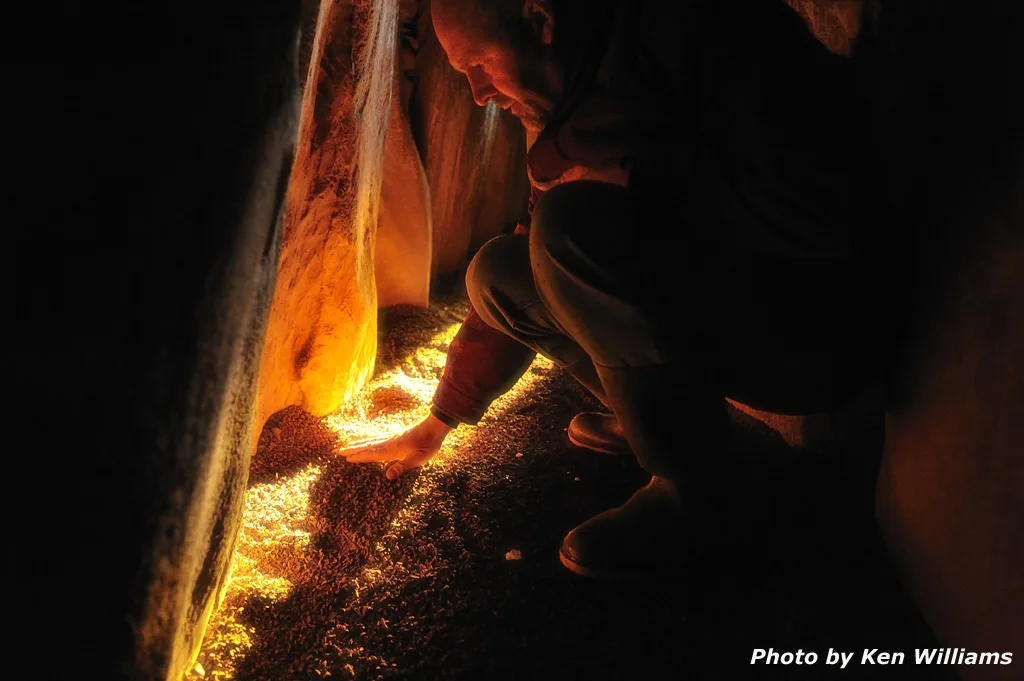
Tour Guide Michael Fox in Newgrange for the Winter Solstice Sunrise in 2010
You can visit Newgrange on a private tour while visiting Ireland’s Ancient East. Our guides explain the roof-box, the carved stones, and the Boyne Valley setting.
Newgrange Winter Solstice Archive

- 21st December 2025 Winter Solstice
- 19th December 2024 Winter Solstice
- 19th December 2023 Winter Solstice
- 20th December 2022 Winter Solstice
- 20th December 2020 Winter Solstice
- 18th December 2016 Winter Solstice
- 20th December 2015 Winter Solstice
- 19th December 2014 Winter Solstice
- 21st December 2013 Winter Solstice
- 18th December 2011 Winter Solstice
- 22nd December 2010 Winter Solstice
- 19th December 2010 Winter Solstice
- 18th December 2010 Winter Solstice
- 22nd December 2009 Winter Solstice
- 21st December 2009 Winter Solstice
- 21st December 2008 Winter Solstice
- 21st December 2007 Winter Solstice
- 22nd December 2006 Winter Solstice
- 21st December 2006 Winter Solstice
- 21st December 2005 Winter Solstice
- 20th December 2005 Winter Solstice
- 21st December 2004 Winter Solstice
- 19th December 2004 Winter Solstice
- 21st December 2003 Winter Solstice
- 22nd December 2002 Winter Solstice
- 21st December 2001 Winter Solstice
Ireland’s Ancient East FAQ
Planning the visit
What is Ireland’s Ancient East?
Ireland’s Ancient East is Fáilte Ireland’s name for the historic east of the country. It is a region where history and modern life meet. You can walk medieval streets, see gardens, and follow 5,000 years of heritage. Newgrange in the Boyne Valley is often the first landmark people seek.
How does Newgrange fit a private day from Dublin?
The Boyne Valley is about one hour north of Dublin. Your private tour includes hotel pickup and return that evening. Newgrange is usually the first major stop, as part of about three hours at Brú na Bóinne. After that, two extra stops usually fill the rest of the day without rushing.
Can we go inside Newgrange?
Yes. The standard OPW visit includes the passage and chamber, subject to tickets and any limits on the day. Knowth is different. Visitors do not enter Knowth’s passages. For a full site briefing, see Visiting Newgrange.
Tickets
Do we need tickets?
Yes for Newgrange and Knowth. Pre-booking is essential for those monument tours. Every visitor, including children, needs a ticket. We purchase the required Brú na Bóinne tickets on your behalf, subject to availability. Many other Ancient East stops nearby do not need an entry ticket. That includes the Hill of Tara, the Hill of Slane, Monasterboice and several abbey grounds.
What happens if Newgrange tickets are unavailable?
We reshape the day. You might visit Tara, Trim Castle, Monasterboice or Old Mellifont Abbey. We will not confirm a Newgrange entry until we have secured the tickets.
Is Newgrange worth visiting if we cannot be there at the solstice?
Yes. The OPW tour still takes you into the passage and chamber, and the guide explains the alignment. Many people experience Newgrange outside the lottery mornings and still find it a highlight of Ireland’s Ancient East.
Walking
How much walking is involved?
Expect outdoor walking on gravel paths, grass and uneven ground. The passage at Newgrange is narrow. Shelter at the monument is limited, so bring a waterproof jacket and an extra layer.
Can the day be adjusted for mobility or personal interests?
Yes. This is a private tour, so we can customize later stops. Tell us if you prefer less walking, more time at one site, or a different mix of tombs, abbeys or later history.
Lunch and other practical questions
Is there time for lunch?
Yes. We stop for lunch during the day. The tour price does not include meals.
Are tolls, fuel and parking included?
Yes. All car expenses are covered by the tour price, including tolls, fuel and parking.
What else can we see nearby?
Nearby stops include the Hill of Tara, Trim Castle, Drogheda, and Slane. Loughcrew Cairns in Meath catch equinox sunrise. Farther south, Glendalough in Wicklow is another Ancient East landmark. A private day can include Knowth on the same OPW visit.
Visit Ireland’s Ancient East with Boyne Valley Tours
Enjoy a private day from Dublin. We handle the driving and the timing. Newgrange and Knowth need reserved tickets, and we purchase those on your behalf, subject to availability. Many later stops do not need an entry ticket. The usual first-time route starts at Brú na Bóinne, then continues to Tara and the Hill of Slane. Tell us if you want less walking, more abbeys or a quieter tomb instead. You can see the wider choice of Boyne Valley sites on the companion page.

Newgrange & Boyne Valley

8hrs | €675 + Booking Fees


Boyne Valley Castles & Abbeys
8hrs | €675 + Booking Fees

Meath Megalithic Sites
8hrs | €675 + Booking Fees

Glendalough & Scenic Wicklow
8hrs | €675 + Booking Fees

Wicklow Gardens & Scenery
8hrs | €675 + Booking Fees

Cruise Excursions
8hrs | €675 + Booking Fees